
Fantastic Find at the Bookstore #2

dick and jane

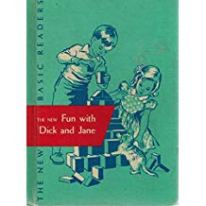
If you learned to read at school in the U.S., sometime from the 1940’s to the 1960’s, there’s a good chance that you learned with the help of Dick and Jane, their little sister, Sally, and the pets, Puff and Spot. By today’s standards of instructional materials for reading, this basal series was quite dry and some might say boring. I loved those books in my first years of school, mainly because…I WAS READING!

Dick and Jane pages

Fast forward many decades, when I trained to become a teacher and landed my first elementary position in Michigan. Although we still used a basal series in fourth grade, that year, it was packed with “real literature” and was supplemented with sets of award-winning chapter books, in addition. By the time I served as a Chapter I reading teacher in North Carolina and later taught kindergarten back in Michigan, sets of charming leveled books (like “Mrs. Wishy-Washy“) had replaced all basals. Reading instruction methods, assessment, and progress tracking had been fine-tuned, as well.

During my years of teaching and even after I retired, collecting vintage children’s readers was a hobby that I enjoyed immensely. Many of those 30+ books were the Dick and Jane variety, while some featured other children, pets, and retold folk literature. I had a few favorites, like the cover that’s pictured above, which I can actually remember from childhood. I had read an article, once, that revealed the Dick and Jane characters originally were a part of other collections before they appeared in their “own series”. These early books were known to be quite the collectors’ items and sometimes brought hundreds of dollars. I stored this information in the back of my mind, but didn’t really remember the details.

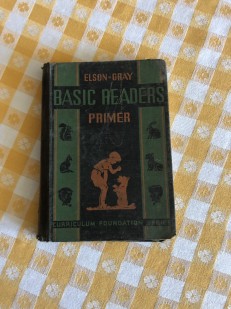
One day, as fate would have it, I was looking through shelves of used books in a little shop near St. Louis, Michigan. I picked up an old school reader that was in pretty rough shape. My heart started beating a little faster, since the Elson-Gray name on the scarred cover rang a bell. I leafed through the book, being careful not to tear the somewhat brittle pages any more than they already were…Billy and Nancy, Alice and Ned, DICK AND JANE!!!

pages inside oldest Dick and Jane

I tried not to be too overjoyed, since I couldn’t tell if the price penciled near the front of the book said $2.00 or $200. Yes, I really wanted that 1936 edition, but it wasn’t in great shape, and I’ve never spent that much money on a book in my life. Holding my breath, I walked up to the counter. Luck was with me that day, and I still have the receipt for $2.12, with tax.

When I moved from Michigan to Texas a few years ago, I was forced to dramatically cut back on the books that I would pay to ship, since I had collected many different types, over the years. As an end result, I saved just five of my children’s readers, including three regular Dick and Jane books and this very special precursor of what they would later become. I’ll treasure it forever, along with the memory of that day.
oldest Dick and Jane

I’d love to hear from you in comments if you learned to read with Dick and Jane, or if you would just like to share a memory about learning to read!


Don Freeman: the Winding Path to Children’s Bookshelves

Come One Come All Don Freeman cropped copty

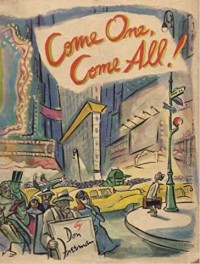
I recently wrote about my “fantastic find” at a bookstore of a signed copy of Hattie the Backstage Bat by children’s author, Don Freeman, which also sports an original illustration! This made me curious to find out more about the person, himself. I learned that he had written an autobiography as a young man before he and his wife had become published in the world of children’s literature.

The book, Come One, Come All, tells about his somewhat unusual childhood in California and his very early dreams about moving to New York and becoming an artist. It recounts his later struggles in New York, during the Depression, first supporting himself by playing the cornet in dance bands. We follow Mr. Freeman as he finally squirrels away enough savings to take painting classes with the inspirational artist, John Sloan.

Eventually, Don Freeman seems to find his artistic niche behind the scenes in the world of the theater. Some of his articles and illustrations were published in newspapers such as the New York Herald Tribune, the New York Times, and PM, in addition to making appearances in publications such as Stage and Theater Magazine.

Readers interested in the heady atmosphere of New York leading into the early 1950’s will find this to be a very interesting window into that period. The book ends happily with Don and Lydia, a young woman he had met earlier in California, getting married. We say goodbye to them as they are both experiencing their first tastes of professional success. What really grabs me about this well-written and charmingly illustrated book is that they had no inkling at the time how successful and admired they would later become in the realm of children’s literature.

This 244-page book was not a simple one to find! A few copies were available through Amazon or eBay for hundreds of dollars, each. That wasn’t going to happen, as much as I wanted to read it. Hurrah for WorldCat, the inter-library option, and I did find the book listed there!

The copy that I borrowed was through a university’s library and has been rebound, so no longer wears the interesting, illustrated cover shown above. No matter, since this copy DOES have something else that I find to be so intriguing. Tucked into the back is what I imagine to be the original card! This chronicles check-out dates in the 50’s through 60’s and being “mended” in the early 70’s. The borrowers’ names have been blacked-out, as shown, below. I love those old library cards and treasure a few used books in my personal collection that contain these. Digital means of book management are efficient, but sometimes I feel sad that we’ve lost a certain sense of history in the transition.

library card 2 001

Talking with Kids about Climate Change

After reading this week that some of Earth’s “old” polar ice is breaking up for the first time on record and that the current administration plans to further relax the pollution rules, I felt frustration beginning to boil. What to do? Write about it! No, I’m not going to write a children’s book about climate change (at least not now:) but I AM going to tell you about several good literature choices that are available. These books can help you broach this topic with our young and up-coming scientists, activists, and caretakers of the Earth.


The Tantrum that Saved the World is by Megan Herbert (writer and illustrator) and Michael E. Mann (climate scientist). This rhyming book is available in hardcover and e-book from World Saving Books in Amsterdam. In the story, various people and animals who have been displaced by climate change come knocking. They don’t just want a place to stay, though; they want to get busy and make a change!

The story is easy to understand for young children, and the colorful illustrations add to the enjoyment. Toward the end of the book, you’ll find informational pages about the science of climate change that will add even more depth for somewhat older readers. The print book includes an action plan poster, and the e-book version offers a PDF of the poster, as well. Bill Nye the Science Guy recommends this book, which is certainly high praise.


The Magic School Bus and the Climate Challenge is just one of the adventures in this science series for kids written by Joanna Cole and illustrated by Bruce Degen. As a teacher, I loved sharing these stories of Ms. Frizzle and her class with my own enthusiastic students.

This particular book from the series explains in a kid-friendly way just why the Earth is getting warmer and explores what the children can do about the situation! The lively illustrations tell even more of the story beyond the text. Available in hardcover, paperback, and audio.

I’m wondering if any of you have read and discussed either of these books with your own children or students. If so, I would love to hear about the experience. In addition, please feel free to share any other titles on the topic of climate change geared toward young kids all the way up through YA! 

~Becky

Critique Group: what we bring to the table


The first Wednesday evening of each month finds me at the local library rearranging the tables for critique group. This gathering of writers and illustrators for children’s works has taken place for about 18 months, now, and has evolved a great deal during that time. Attendees come and go with their own particular needs, which is to be anticipated with this type of group, and a usual core of ‘regulars’ shows up on a dependable basis.

Members include those who are traditionally and self-published, in addition to those who are seeking their first publication, or who might just enjoy the process of writing. We share our works in progress, give voice to our successes and disappointments, offer praise and helpful advice, in addition to discussing common concerns related to our craft and industry.

I think that the biggest change I have seen during this time is the wide variety of creations that those attending bring in to read, show, and discuss. Yes, writers still share complete and partial picture books or chapter book texts. In addition, we’ve mulled over many a query letter and just had our first taste of a press release, as well. Illustrations now run the gamut from sketches to full-color renderings and include those to be used in picture books, magazine/newspaper stories, social media banners, and for pure inspiration!

Bottom line, there’s a great deal of “work” and communication that needs attention, beyond the specific written and/or illustrated products that we hope to publish. Within our ranks, we’re finding a supportive environment for ALL of those needs, and we’re each adding to or reinforcing our personal knowledge with every new encounter.

I can hardly wait to see what the second half of this year brings!

If YOU belong to a critique group, I would love to read comments about the types of works that are shared.

~Becky~


Inspired by a Dream

winter scene from Pixabay.jpg no attrib. req.It began as one of those dreams where the setting and events that were unfolding seemed simultaneously familiar yet unfamiliar. Instead of watching the vision like a movie, I was taking part and looking out through the woman’s own eyes toward three children gathered around a kitchen table. A snowy scene beyond the window was as well-known to me as the back of my hand.
The mood was both comforting and uncomfortable. I started to waken, but willed myself to remain in that place. Every inch of the room was recognizable to me, as were some of the occupants. As I held onto the dream, I knew without a word being uttered what had happened to these people and what their futures held.

Next, I just needed to wake up and write the story!

Several years after that writing, the resulting short fiction, “Slip of the Lip,” now appears in the 2018 edition of the UPPAA’s anthology, the U.P. Reader. That publication is an intriguing mix of fiction, non-fiction, prose, poetry, and photography, with its roots planted firmly in Michigan’s Upper Peninsula. I’m proud to have my writing once again included, along with so many talented contributors.

UP Reader 2nd Edition

What Draws Children to Certain Books?

flicka, ricka, and dicka

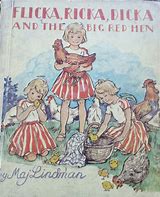
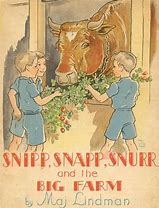
During much of my childhood, the public library in our little town was housed in a small area adjacent to the fire station. Each time I arrived at the library with my family, I worried that the fire alarm might sound during our visit. However, I remember a span of several years when I would hurry immediately to a certain shelf where the books by Maj Lindman were lined up, and I soon forgot all my worries.

This author/illustrator from Sweden produced several series of picture books from the 1920s through the 1960s, including those featuring the triplet boys, “Snipp, Snapp, and Snurr,” and also the set of titles built around triplet girls, “Flicka, Ricka, and Dicka.” I’m happy to say that I’ve collected one from each series, which are library editions published in 1960. I see that Albert Whitman & Company has reissued many of these books (some with paper dolls, no less!); but, for me, those actually printed during my childhood mean so much more.

While looking my copies over, recently, I considered what it was that I had liked so much about them as a child. Possibly I can put some of my discoveries to use when fashioning my own books for young readers. I came up with the following factors:

  • Settings – The country’s name, “Sweden,” is stated in two out of the three books that I own in these series. Even when not mentioned outright, the setting depicted in the book feels very different from my neighborhood that was in the midst of a small town in Michigan.
  • Freedom  – Since many of the stories take place on farms or in other rural areas, the children often seem quite free to roam as they please and have many adventures that often involve animals, as well.
  • Names – Beyond the triplets’ monikers, many of the other characters have names that were also unfamiliar and interesting to me.
  • Family structure – Until I was somewhat older and a nearby neighbor gave birth to triplets, I had never known any such families. (Imagine my surprise when that trio was made up of one boy and two girls!).
  • Visually appealing – The lovely, full-page illustrations are so pleasing to the eyes, and many of the editions use a somewhat enlarged and easy-to-see font.
  • Simple stories that often involve extended families – This serves as a vehicle to get the children away from their homes and broadens the story options.
  • Surprise endings or subtle lessons to be learned – As I remember, the resolutions seemed satisfying to me as a child.

All that being said, it appears that some of the books are rather long and run over 1200 words. My mother preferred to read shorter books for story time, especially since I also had an even younger brother. My father usually chose to tell us stories that he made up, on the rare evenings when he arrived home early enough from work. My older sister was always eager to read to me, though, for which I am forever grateful.

snipp, snapp, snurr

Although the type of stories that appeals to today’s children has evolved, I’m sure, I believe that there are still some nuggets of basic childhood yearnings to be found in the pages from our youth. I’d love to hear about your favorite childhood books and what it was that drew you to them!


Happy B-day to Me & to Our Critique Group

flowers and computer

This is my birthday week, and I’m tempted, of course, to reflect on fond memories and post a few vintage pictures. I’m sure to do that in the future, but I’ve decided to look forward on this anniversary of my birth. Personal goals in the coming year are to form even firmer bonds with those individuals who matter to me AND to pursue further publication of my work with renewed structure and vigor.

I’m happy to say that I belong to several national and regional organizations that help to support writing and publication goals. I took advantage of local offerings and joined a writing critique group at the library soon after my move to Texas. Its members write in various genres and come from many different walks of life. We present our works for group feedback, share pertinent writers’ questions or information, and celebrate our successes.

Sometimes that meeting just once a month wasn’t quite enough to keep me motivated. About a year ago, I pursued the concept of a critique group for writers and illustrators of children’s literature, and “Write 4 Kids” was born! We also meet once a month at the library to present our works-in-progress, including books, stories, illustrations and query letters for potential publishers and agents.

In addition to providing feedback, we also share questions, information, disappointments and successes. Our numbers have grown steadily, and attendance continues to motivate and enlighten a group of local authors and illustrators. The input, friendship and support of both groups have been invaluable to me.

Another personal goal for the upcoming year is for my continued growth as an effective critique group member. Sometimes it’s too easy for one to offer a possible “fix” for a piece. The first order of business should be a focus on the positives and “what works.” I have to admit that my work as a freelance editor sometimes causes me to look for small surface errors instead of focusing on the “broad picture.”  I must remember to practice what I preach!

As always, soon after my birthday comes the first day of spring. I hope that your own season of renewal, wherever you’re located, will bring beauty, hope, and happiness.

Becky


Peter Mayle: A Life in Provence

provence


I was recently saddened to learn that one of my favorite authors, Peter Mayle, has died. The first book I ever bought by Mr. Mayle was Where Did I Come From?, which was purchased over 40 years ago in anticipation of telling my children about the facts of life. Decades later, when I was introduced to his travel memoir, A Year in Provence, I had no idea that this was even the same author. During the intervening years, he had published several other books for children and worked in advertising. He and his wife then took the plunge and gave up their lives in England to relocate in France.

The book was serialized for the BBC, and I came across the videos (yes, videos) at the library, while living in Michigan’s Upper Peninsula. Filmed in Provence, the story was mesmerizing. I could relate in some small way to what he and his wife faced, having myself moved to various parts of the U.S. and adjusted to unfamiliar cultures. Those changes never required learning another language, however!

The views and vistas portrayed in the films were like nothing I have ever had access to on a daily basis, even in the most scenic areas of Michigan’s Great Lakes, North Carolina’s shores, Virginia’s mountains, or Texas Hill Country. Beyond the story’s familiar theme of moving to a different type of world, one can also find the more elusive theme of life never being too far along to try something new. This is such an important belief, and I think it resonates for many of us.

The mini-series wasn’t a critical success, evidently, although John Thaw’s portrayal of Peter Mayle was excellent. I loved it, though, and have watched it more times than I care to admit. Thanks to finding the series on the dusty bottom shelf at the library, I was led to the body of works by this wonderful author. I still remember the pleasure of cuddling up by the fireplace with a snowstorm raging outdoors and experiencing the warmth of the French countryside and the scent of lavender.

Peter Mayle wrote several successful sequels to that book, which are presented a bit more like collections of short stories. All the books contain humor, food, wine, weather, friendship, local culture and beautiful locales. How else would I ever have bumped into truffles (the mushroom-like fungi, not the chocolates), boules, the mistral, or pastis? This author wrote other enjoyable non-fiction, in addition, usually centered on various interesting aspects of French culture. To my delight, there were also his novels to devour, which portray many of the same characteristics as his memoirs, along with crimes solved, business deals conducted and wine produced. There’s some romance to be found, as well. A lovely movie with Russell Crowe and Marion Cotillard is based on Mayle’s book, A Good Year.

With regret, I have to admit that I didn’t bring the entire collection of Mr. Mayle’s books with me when I moved. I did keep A Year in Provence, of course, and I especially value my ARC (advance reading copy/uncorrected proof) of A Good Year, with the plain blue cover. This format seems just that much closer to the author’s keyboard, somehow.

Try his first book, and if you love it, you’ll have a treasure trove to explore beyond that one. I’m extremely sorry that he’s gone, but surely this author knew that his writing had affected the lives of others, as evidenced by the book sales and fans, increased tourism to Provence, and readers who sought him out when visiting the region.

Merci, Monsieur Mayle!

What Makes an Effective Writing Critique Group Member?


I’m very thankful for the two local critique groups that I attend and always leave feeling renewed and inspired. One is a well-established combination of writers from all different genres. I lead the second one, which is a newer compilation of writers and illustrators for children’s literature. Each group meets in person monthly, and occasional digital critique swaps are also requested and take place in between our gatherings. Since I’ve been taking part and observing for some time, now, several aspects for effectiveness have jumped out at me and motivated the following suggestions:

*When commenting in writing or orally, try to start out with a positive, follow with suggestions, and possibly end with another positive, as time allows (“sandwich” approach)

*Point out specific sections of the pieces for examples whenever possible, instead of speaking in generalities

*Keep in mind “nerves” and any misgivings you may have had when you first joined the group, upon greeting new attendees

*When receiving feedback, try to listen to a member’s full comments before responding with an explanation of your thinking or reasoning (this can be difficult to do!)

*Share your successes AND your disappointments, which can help to form connections between members

*Offer critiques on a continuing basis, even during those times when your own work is not being shared

Am I ALWAYS successful in remembering to do each of these things? I admit that I’m not, but these are my goals, since I can see how these strategies work so well when implemented. Feel free to add comments with ideas you’ve found to be especially helpful in your own groups!

Windows Open!


In the Midwest, the invigorating change of the seasons was often marked by melting or returning snows, reappearance or disappearance of greenery and flowers, along with changes in the patterns of wildlife visiting the yard. In Texas, transformations related to precipitation, flora and fauna are much more subtle to the non-scientific eye. For me, the main difference is whether or not I can comfortably open my windows. With a twenty degree drop in the temperature since yesterday, today is one of those marvelous days to open the windows wide.

This may sound like such a simple and even mundane act, but it’s an activity that many Texans, who are accustomed to such high temperatures, often seem to overlook. Indeed, many of the local apartment buildings, including my own, do not include window screens. That presents a choice to be made: leave the windows closed at all times, open them and risk unwanted flying visitors, or add some sort of protection. During my first autumn here, I remembered a type of free-standing window screen from childhood that opened like an accordion to fit various sized apertures. Where was my handy neighborhood hardware store when I needed it? Impatience had a hold on me, and ordering through the internet would have taken too long. Surprisingly, I found several at Wal-Mart, after sifting through a pile where many seemed to be damaged. I was on my way to opening my windows.

The next issue was how to make sure the new screens didn’t fall out onto those passing below, since their fit into the window opening isn’t exactly fool-proof. I found articles posted by individuals on the internet about just this topic, with suggestions that involved carpentry (not for me), Velcro, and removable adhesive putty. I went with a white version of the latter, since I was familiar with its easy and mess-free use from mounting things on my classroom walls as a former teacher. Just one little wad on each wooden end piece, while leaving my window closed a little farther than the height of the screens, and I secured them in place. Depending on the configuration of your windows, this may not be an air-tight fit, and you might still need to be on the lookout for small insects. I would certainly avoid these types of screens if I had a curious pet or young child.

Today’s cool breezes feel glorious. I can hear light traffic noises, occasional bird calls and distant voices. When opening the windows, we also put ourselves out there and share somewhat personal snippets of our lives, such as escaping cooking smells, voices, and the sounds of our favorite music, television program or current audio book.

The act of writing is a bit like opening windows. In sharing memoir and personal essays, we reveal our beliefs, feelings and memories to the world. Even in fiction, we raise the sashes that protect our personal experiences on which plots and characters are often based. We take a chance on rejection, disregard, or disagreement when opening ourselves up to the public, whether we share through a critique group, blog, website, self-publication, or if we publish in a traditional format. The potential rewards are many. Other writers and the public at large often embrace our written ideas and may offer helpful feedback, as well.

As writers, we should try to avoid being fearful of the results, take chances, and open our windows to the world beyond.