About the Holiday: National Wildlife Day was established in 2005 by author and pet lifestyle expert Colleen Paige in memory of conservationist Steve Irwin. The day promotes awareness of the importance of conservation of animals, habitats, and the environment worldwide and offers education on the number of endangered and threatened species across the globe. To […]
The day after Labor Day was always the first day of school in Michigan. One of my earliest memories is of my older sister, Terri, heading out for school the year I must have been four. I can see myself sitting in the bay window of our living room, and she alerted me that she was leaving for school, but mentioned how “lucky” I was that I got to stay home and watch “Ding Dong School” on television.
It all seemed rather dubious to me, since I WAS looking forward to kindergarten the next year, but it was kind of her to make the attempt. My mother looked on and seemed to be trying to gauge my response. I suppose it was hard for me to face summer’s end and be the only child remaining at home, since my younger brother was not yet born.
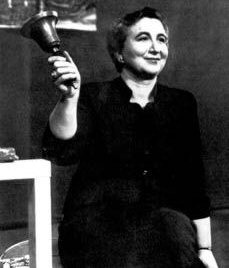
I DID love the show, however, and since we only had clear reception of one network in our little town in Northern, Lower Michigan, I was lucky that it ran on NBC through 1956 (followed by syndication for some years after). The presenter, Dr. Frances Horwich, known to the young viewers as our teacher, “Miss Frances,” had a calm, soothing voice that seemed to be aimed directly at me. The show always began with her ringing the large school bell, of course. She read books to us, presented various types of interesting lessons, and demonstrated art projects. Children often sent their drawings and other works in to the show, and Miss Frances would sometimes share those, as well.
Sources reveal that she was an experienced educator, but had very little familiarity with working in front of the camera. From a kid’s point of view, the show felt very natural and real, as if I was actually there in her classroom. Due to the show’s popularity, many different types of products carrying the “Ding Dong School” name became available, like finger paints, balloons, valentines, and records. I don’t remember having any of those, but we did own some of the “Golden Books,” such as these shown. Titles often focused on family, community, and the use of imagination in play.
My afternoon kindergarten the following year paled in comparison, naturally. With a large room full of actual children and no helpers that I can remember, I’m sure that our teacher had her hands too full to give us much individualized attention. I kind of missed those mornings spent at home in our sunny living room, with my mom nearby and Miss Frances talking to me out of the black-and-white television like I was the only kid in the world. Little did I know at the time that my future would also find me as a teacher in the classroom with young children.
When Ebay was still a novelty, I often looked up collectibles that interested me. One day, I saw some of Frances Horwich’s personal items related to the show up for auction, following her death, such as a custom-made chair with her name on it, her collection of school bells, and awards that she had received. I did some research and learned that she and her husband had no children, so I suppose there was no one in particular to leave these types of things in a will. At first this seemed very sad, that her belongings would simply go to the highest unknown bidders on the Internet. After giving this some more thought, however, I realized how insignificant “things” really are and how many thousands of individuals, like myself, remembered this woman for providing them with a pleasant first education experience. That seemed much more important, in the grand scheme of things.
Growing up in the small town of Tawas City, Michigan, in the early to mid-1960’s, Friday night at the East Tawas Rollerdrome was THE place to go! My best friend, Jean, and I practiced skating without falling down and flirting with boys who were also trying to act cool and make it around the rink without hitting the wooden floor. If I close my eyes, I can still hear the rumble of wheels, smell the dust, and also hear the corny music, which thankfully evolved into “by request,” for teens who were willing to bring their own records from home. Here’s an image of the sticker from that establishment of long ago.
After reading this week that some of Earth’s “old” polar ice is breaking up for the first time on record and that the current administration plans to further relax the pollution rules, I felt frustration beginning to boil. What to do? Write about it! No, I’m not going to write a children’s book about climate change (at least not now:) but I AM going to tell you about several good literature choices that are available. These books can help you broach this topic with our young and up-coming scientists, activists, and caretakers of the Earth.
The Tantrum that Saved the World is by Megan Herbert (writer and illustrator) and Michael E. Mann (climate scientist). This rhyming book is available in hardcover and e-book from World Saving Books in Amsterdam. In the story, various people and animals who have been displaced by climate change come knocking. They don’t just want a place to stay, though; they want to get busy and make a change!
The story is easy to understand for young children, and the colorful illustrations add to the enjoyment. Toward the end of the book, you’ll find informational pages about the science of climate change that will add even more depth for somewhat older readers. The print book includes an action plan poster, and the e-book version offers a PDF of the poster, as well. Bill Nye the Science Guy recommends this book, which is certainly high praise.
The Magic School Bus and the Climate Challengeis just one of the adventures in this science series for kids written by Joanna Cole and illustrated by Bruce Degen. As a teacher, I loved sharing these stories of Ms. Frizzle and her class with my own enthusiastic students.
This particular book from the series explains in a kid-friendly way just why the Earth is getting warmer and explores what the children can do about the situation! The lively illustrations tell even more of the story beyond the text. Available in hardcover, paperback, and audio.
I’m wondering if any of you have read and discussed either of these books with your own children or students. If so, I would love to hear about the experience. In addition, please feel free to share any other titles on the topic of climate change geared toward young kids all the way up through YA!
National Lighthouse Day can’t sneak past me without a mention of my experiences with those stately structures. I didn’t truly understand, while growing up in a small town on the shores of Lake Huron, in Michigan, how lucky I was to have such easy access to Tawas Bay and the beautiful lake, with its moaning fog horn and elegant lighthouse. Years ago, the light wasn’t open to visitors, as it is now, but I loved the hot summer days when my parents would drive all the way out to the end of Tawas Point so that my siblings and I could gawk. Many a rainy night I fell asleep to the comforting sounds of the foghorn, in the distance.
As an added bonus, we often traveled north along the lake shore toward Rogers City, to visit relatives. This gave us a chance to view several other pretty lighthouses along the way, such as the one at Sturgeon Point, and when we reached our destination, near Forty Mile Point.
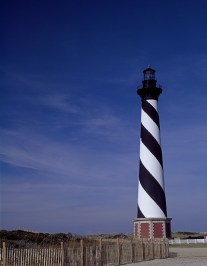
Michigan isn’t the only state to sport lovely lighthouses, of course. I had the opportunity to visit several that are situated along the Atlantic coast of the United States while living in North Carolina, such as the lights of Bodie Island (left) and Cape Hatteras (right). Quite the tourist destinations.
Years later, when a teaching job brought me back to Michigan’s Upper Peninsula, I discovered an entirely new group of lighthouses to explore along the shores of Lake Superior. Several that had become private enterprises, such as at Sand Bay and Big Bay, even rented out rooms to overnight guests, which was great fun!
One of my favorite Michigan lighthouses, and possibly the last one I visited before moving to Texas, is pictured below at Ontanogan. It offers an impressive museum area to show visitors what life might have been like for early “keepers of the light.”
Although my writing was prompted by our country’s National Lighthouse Day, the title of this piece also opens its arms to encompass an important spot in Ontario, Canada, as well. I spent several lovely vacations there, near Bruce Mines (below), and couldn’t complete this post without including that memory.
Vintage photo of unknown neighbors and what years later would become my home. The border is formed from wallpaper recovered within the kitchen walls!
Decades ago, my former husband and I bought a fixer-upper home that had been built around 1900 in a small town of Michigan’s Upper Peninsula. The house needed tons of work, and we basically lived upstairs while we began remodeling the first floor. When I say “we,” I mean mainly that he did the carpentry, and I cleaned up during and after the work was completed.
Since the kitchen was on the first floor and needed to be functional as soon as possible, that room was one of the priorities. While taking out the drawers in the kitchen for painting and new hardware, a small notebook was found jammed into the deep, dark depths of a cabinet. The booklet’s pages were somewhat discolored, and the brown, waxed cover bore the words “Memorandum Book.”
Within those lined pages, I discovered a delightful collection of handwritten recipes and helpful household hints. Some of them were even affixed with what must have been the names of the owner’s friends who had shared, as I recognized several of the last names of families living in that and the neighboring town. The penmanship style was similar to that of my mother or aunts who reliably sent letters to keep up on family news. I felt like I had struck gold.
Many of the recipes were desserts, although some were of casseroles or various types of vegetable and meat dishes. Two different versions of the Cornish meat pie regional specialty called the “pasty” were offered. Household hints ranged from a mixture that could be used to soften a hardened paintbrush to a home remedy for cough syrup.
When we said “goodbye” to that house some years later, the notebook found a new home in my paternal grandmother’s wooden recipe box and left with me.
I was recently encouraged to see that an online author acquaintance, Karen Musser Nortman, had put out a call for camping and/or Upper Peninsula recipes to accompany her current Frannie Shoemaker Campground Mystery, which is set in the area. I’m happy to say that the directions I submitted for pasties, “cry baby” cookies, and pasta sauce, all copied from that old notebook, now appear in the fiction book, Real Actors, Not People. What a fun way to recycle a few of those rescued recipes!
It began as one of those dreams where the setting and events that were unfolding seemed simultaneously familiar yet unfamiliar. Instead of watching the vision like a movie, I was taking part and looking out through the woman’s own eyes toward three children gathered around a kitchen table. A snowy scene beyond the window was as well-known to me as the back of my hand.
The mood was both comforting and uncomfortable. I started to waken, but willed myself to remain in that place. Every inch of the room was recognizable to me, as were some of the occupants. As I held onto the dream, I knew without a word being uttered what had happened to these people and what their futures held.
Next, I just needed to wake up and write the story!
Several years after that writing, the resulting short fiction, “Slip of the Lip,” now appears in the 2018 edition of the UPPAA’s anthology, the U.P. Reader. That publication is an intriguing mix of fiction, non-fiction, prose, poetry, and photography, with its roots planted firmly in Michigan’s Upper Peninsula. I’m proud to have my writing once again included, along with so many talented contributors.
During much of my childhood, the public library in our little town was housed in a small area adjacent to the fire station. Each time I arrived at the library with my family, I worried that the fire alarm might sound during our visit. However, I remember a span of several years when I would hurry immediately to a certain shelf where the books by Maj Lindman were lined up, and I soon forgot all my worries.
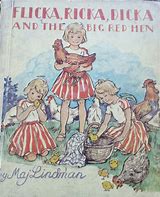
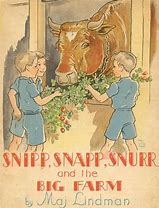
This author/illustrator from Sweden produced several series of picture books from the 1920s through the 1960s, including those featuring the triplet boys, “Snipp, Snapp, andSnurr,” and also the set of titles built around triplet girls, “Flicka, Ricka, and Dicka.” I’m happy to say that I’ve collected one from each series, which are library editions published in 1960. I see that Albert Whitman & Company has reissued many of these books (some with paper dolls, no less!); but, for me, those actually printed during my childhood mean so much more.
While looking my copies over, recently, I considered what it was that I had liked so much about them as a child. Possibly I can put some of my discoveries to use when fashioning my own books for young readers. I came up with the following factors:
Settings – The country’s name, “Sweden,” is stated in two out of the three books that I own in these series. Even when not mentioned outright, the setting depicted in the book feels very different from my neighborhood that was in the midst of a small town in Michigan.
Freedom – Since many of the stories take place on farms or in other rural areas, the children often seem quite free to roam as they please and have many adventures that often involve animals, as well.
Names – Beyond the triplets’ monikers, many of the other characters have names that were also unfamiliar and interesting to me.
Family structure – Until I was somewhat older and a nearby neighbor gave birth to triplets, I had never known any such families. (Imagine my surprise when that trio was made up of one boy and two girls!).
Visually appealing – The lovely, full-page illustrations are so pleasing to the eyes, and many of the editions use a somewhat enlarged and easy-to-see font.
Simplestories that often involve extended families – This serves as a vehicle to get the children away from their homes and broadens the story options.
Surprise endings or subtle lessons to be learned – As I remember, the resolutions seemed satisfying to me as a child.
All that being said, it appears that some of the books are rather long and run over 1200 words. My mother preferred to read shorter books for story time, especially since I also had an even younger brother. My father usually chose to tell us stories that he made up, on the rare evenings when he arrived home early enough from work. My older sister was always eager to read to me, though, for which I am forever grateful.
Although the type of stories that appeals to today’s children has evolved, I’m sure, I believe that there are still some nuggets of basic childhood yearnings to be found in the pages from our youth. I’d love to hear about your favorite childhood books and what it was that drew you to them!
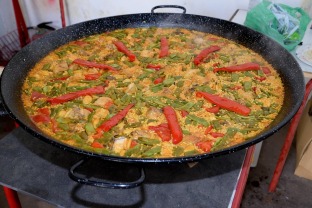
A friend of mine recently expressed a preference for chicken paella over that made with seafood. You know exactly what I was thinking…and the following post is a tried and true recipe for vegetable paella!
I recall an entertaining chapter in Derek Lambert’s book, Spanish Lessons, in which the author’s wife carefully plans a dinner party while they are residing in Spain. Paella will be the main attraction, for which they rent a huge pan to cook the dish over an open fire. In a comedy of errors, two of their “friends” drop the pan and spill much of the ingredients on top of some gravel that had been brought to the yard during their remodel. Not wanting to admit their mistake, the men just scoop up what they can and pick out the obvious pieces of gravel. You can just imagine what happens at the table as the guests begin eating…
No, this recipe doesn’t contain gravel. What is paella, you might ask. It’s a traditional Spanish, or Valencian, dish that contains rice, often various meats or seafood, and a variety of legumes and vegetables. To me, the taste is dictated by the main spice: saffron. Sure, it’s expensive, but adds a deep, earthy flavor that is crucial to success.
Shopping List (amounts vary depending on your preferences)
Saffron Paprika Rosemary (if desired: sprig of fresh or dried) Salt and pepper to taste Olive oil Vegetable stock (have at least 2 cups handy, but could also use part water) Garlic (chopped) Onion (diced) Red, orange, and yellow bell peppers (long slices) Tomatoes (diced: fresh or canned) Green beans (cut: fresh) Eggplant (hefty chunks) Portabella mushrooms (large, cut into thick slices) Chickpeas (canned or pre-cooked) Rice (Arborio or other; I’ve used gluten-free with success)
Soak a healthy pinch of saffron strands in a bit of hot water. In a large, low pan, stir fry the eggplant, onion, garlic, and peppers in olive oil to soften. Add rice (at least 1 cup), stock, tomatoes, saffron, rosemary (if wanted) and a few teaspoons of paprika. Bring to a boil and turn down to simmer, uncovered, for at least 10 minutes. Stir as needed, although some cooks like to allow the rice to cake a bit on the bottom of the pan, being careful not to let it burn.
Add the chickpeas, green beans, and mushrooms. Cook about 15 minutes longer, or until the rice is softened and the mixture is thick and bubbly. If you plan to imbibe, a good Spanish red would go nicely!
A commitment to “Meatless Monday” is easy for me, since I already eat that way most days. According to the website, this movement began in 2003 and is now active in 44 countries. Eating meat-free at least one day of the week is a positive for our health and good for the Earth.
Here’s one of my recipes that has evolved into a vegetable cassoulet, which is like a vegetable stew or casserole. Not sure if Peter Mayle would have approved of this version of a French classic, but I don’t even miss the meat.
As is typical for my recipes, there are many ingredient options from which you may choose your favorites. Make as little or as much as you want, so amounts will also vary according to your needs and plans.
In a kettle with high sides, brown diced/sliced onions, shallots and/or garlic in olive oil.
If you want your end result to be more like a casserole, your mixture can be emptied into a large casserole and will need less liquid (stock) than the more stew-like version.
Add desired amount of vegetable stock, along with your choices from among sliced leeks, mushrooms and fennel bulb. NOTE: Fennel has a hint of a licorice taste. You might also try a slug of ouzo or pastis in its place for the same flavor. Otherwise, a bit of white cooking wine is also a nice addition.
Add cooked/canned white beans (cannellini, great Northern, or even garbanzos).
Include your choices of the following, peeled and/or cut as required:
carrots
green beans
asparagus
Swiss chard
celery
colored peppers
eggplant
potatoes
turnips
parsley and/or thyme, fresh or dried
Adjust liquid as needed. Salt and pepper to taste. If baking, give this at least an hour at 350. If cooking on top of the stove, after your mixture reaches a boil, turn down the heat to a simmer. Cook until veggies are the desired texture.
Pair with your favorite bread and wine, if you wish.






 It began as one of those dreams where the setting and events that were unfolding seemed simultaneously familiar yet unfamiliar. Instead of watching the vision like a movie, I was taking part and looking out through the woman’s own eyes toward three children gathered around a kitchen table. A snowy scene beyond the window was as well-known to me as the back of my hand.

 A commitment to
 Platform Number 4