
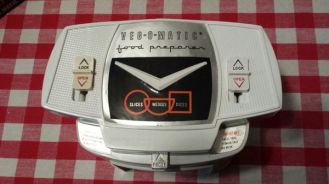
As a kid, I loved the commercials that appeared on television around the holidays featuring people who demonstrated those “slicer and dicer” kitchen tools. Slice-O-Matic, Chop-O-Matic, Veg-O-Matic…you get the idea. Their hands moved more quickly than a magician’s, and I expected a severed finger to surely end up in with the wavy potato slices or the tomato wedges! I remember wondering why my mother didn’t have one of those contraptions, but she always just stuck with her trusty, favorite paring knife.
I’m not really one for kitchen gadgets, myself, and was surprised to find a food spiralizer under the tree this past Christmas morning. Even if you haven’t made any of these spirals, yourself, you’ve probably seen some “ready-made” in the grocery stores, with squash seeming to be one of the most popular. The end results when using this bladed tool are basically vegetables or fruits cut to look like strands of pasta.
The spiralizers evidently come in multiple formats, from various types of rotary incarnations that help the users build arm muscles, to deluxe electric models, with mine being the rotary sort. I’ve experienced mixed outcomes, but still have many fruits and vegetables to try. Eggplant turned out to be too squishy, and the broccoli stems were a challenge, but do-able. My best results, so far, have been with zucchini and summer squash. I won’t resort to calling them “zoodles” or “squoodles,” but they really do resemble noodles and taste great!
The internet is awash with related recipe ideas, but I came up with one based on ingredients that I happened to find in my refrigerator and cupboards, so I’ve included it, below. Feel free to share your favorite spiralizer recipe in comments. In fact, one lucky commenter will be chosen at the end of February to receive a $5 Amazon e-card! Hmmm. Now I’m thinking about a cold spiralized beet salad for Valentines Day…
Seafood Casserole
2 firm zucchini
2 firm summer squashes
Cooked fish, shrimp, or other seafood of choice (any amount you wish; canned works well, too)
Olive oil
Scallions/green onions (the leafy part, which is easiest to cut with kitchen scissors)
Garlic paste (optional)
Shredded cheese of your favorite type (optional)
Pimento slices, mostly for color
Bread crumbs
Spiralize your vegetables with the peel left on and spread out in an oblong casserole that has a bit of olive oil in the bottom. Add your seafood, onions, and garlic paste, if desired. Drizzle about two more tablespoons of olive oil into the mixture. Mix with a fork. Sprinkle cheese, if wanted, and bread crumbs over the top. Bake at 350-360 for 30-45 minutes until heated through.


 “Are you there?” muttered the man into his pillow.
 What remains is a selection of childhood chapter books, Golden Books related to memories but collected as an adult, author-signed novels, and a few vintage tomes that are too wonderful (and smelly) to ever discard. The largest set in the lot is my Dell Mystery Map Backs. As a child, I loved books that included illustrations of maps. Imagine my delight as an adult to discover these wonderfully “campy” mysteries with the great front cover art (although sometimes a bit lurid) and maps on the backs to match the stories. When moving day arrived, the only map backs I had parted with were a few duplicates.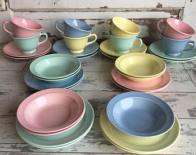
 Although Fiestaware, which is produced by the Homer Laughlin China Company, also of West Virginia, was introduced in 1936, my pieces are not in the realm of vintage, unless that includes a set purchased through the J.C. Penney catalog in the 1990s. I had admired these colorful, sturdy dishes at the homes of friends as a child, and when I had the chance to purchase dinnerware of my own they seemed like the logical choice. Fiestaware is available in a wide range of colors, and my set is composed of deep pastels, including turquoise. Over time, I’ve also added select pieces in red to be used as serving dishes. I often make use of the small plates and bowls while “cooking for one” and display the reds in my Hoosier-type cabinet in the fall and around the holidays.
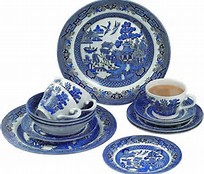 Willow is an elaborate design that has been used on kitchen ware for hundreds of years and probably got its start as Spode transferware. Various colors have been used, and mine is all of the popular blue variety. The lovely scenes that are depicted include detailed buildings, gardens, bridges, and figures, which found their inspiration in wares that originated in China. Various companies appear to use these patterns, and my wide assortment came from both grandmothers, my father’s oldest sister and my mother. They all remembered that I had expressed an interest in those dishes as a child, and that fact makes me treasure them even more. I sometimes use the small bowls or plates and regularly display my favorites. The patterns vary and several that really catch my eye are the ones made in Holland that include camels in their designs.

 Platform Number 4