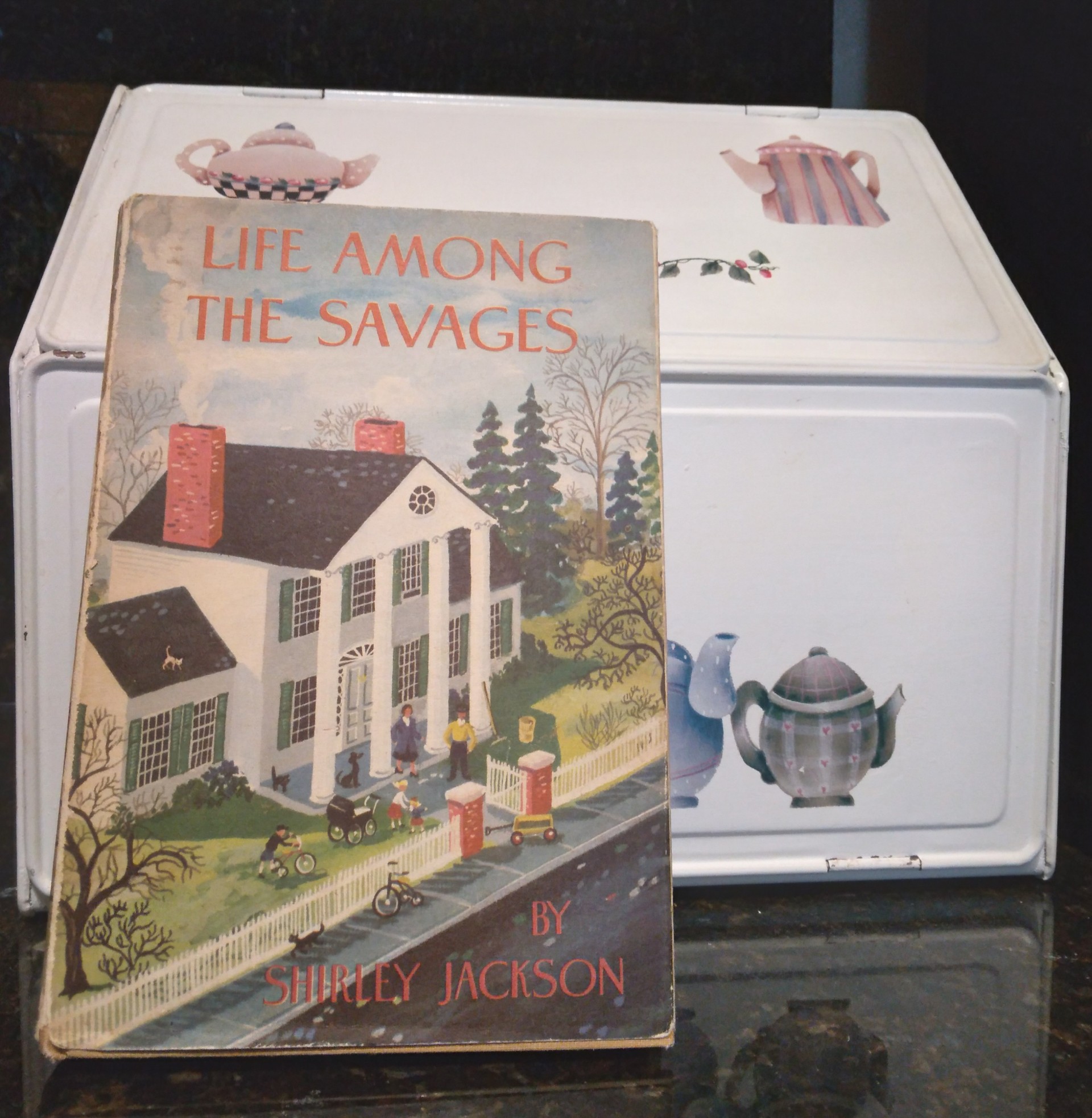
I picked up this book in a used bookstore in Michigan about 25 years ago. It was the charming artwork on the dust jacket that drew me in. Such a lovely family scene. It wasn’t until later that I put “two and two together” about the author, Shirley Jackson!
My first experience with media related to Shirley Jackson was watching the black-and-white movie version of her book The Haunting of Hill House. I was in high school and had come home early from a weekend date with a high temperature. I lay on the couch and watched the only thing that looked interesting on our two available TV stations. The movie, The Haunting, was definitely creepy, and I usually like non-bloody scary movies. Or was it just my temperature and fatigue making me feel somewhat delirious? No, my mom thought it was too creepy, and she went to bed. I watched through my fingers until the sinister ending.
Years later, in college, I read her famous story, “The Lottery,” and wrote a paper (on an old standard typewriter) about The Haunting of Hill House. I also sampled other stories from her collections. Psychological horror and literary suspense at their finest! I loved her writing. So where did Life Among the Savagesfit in? I needed to know more!
I discovered that Shirley Jackson was married to a college professor, and they raised four children, with much of that time spent in the house depicted in the stylized art on the dust jacket. Shirley Jackson was a not-so-typical mother of the 50s, trying to raise kids AND to contribute significantly to the family income. It wasn’t all “fun and games.” Just beneath the surface of her amusing tales, we sense a woman on the edge who struggles to reach her writing goals while caring for a home and children, with a husband who offers little help or true emotional support. Shirley Jackson certainly had a dark side. She often dealt with anxiety and a sense of exclusion. But she wrote delightfully about the chaos of family life. For me, she’s right up there with close contemporaries, such as Betty MacDonald, Jean Kerr, and Erma Bombeck.
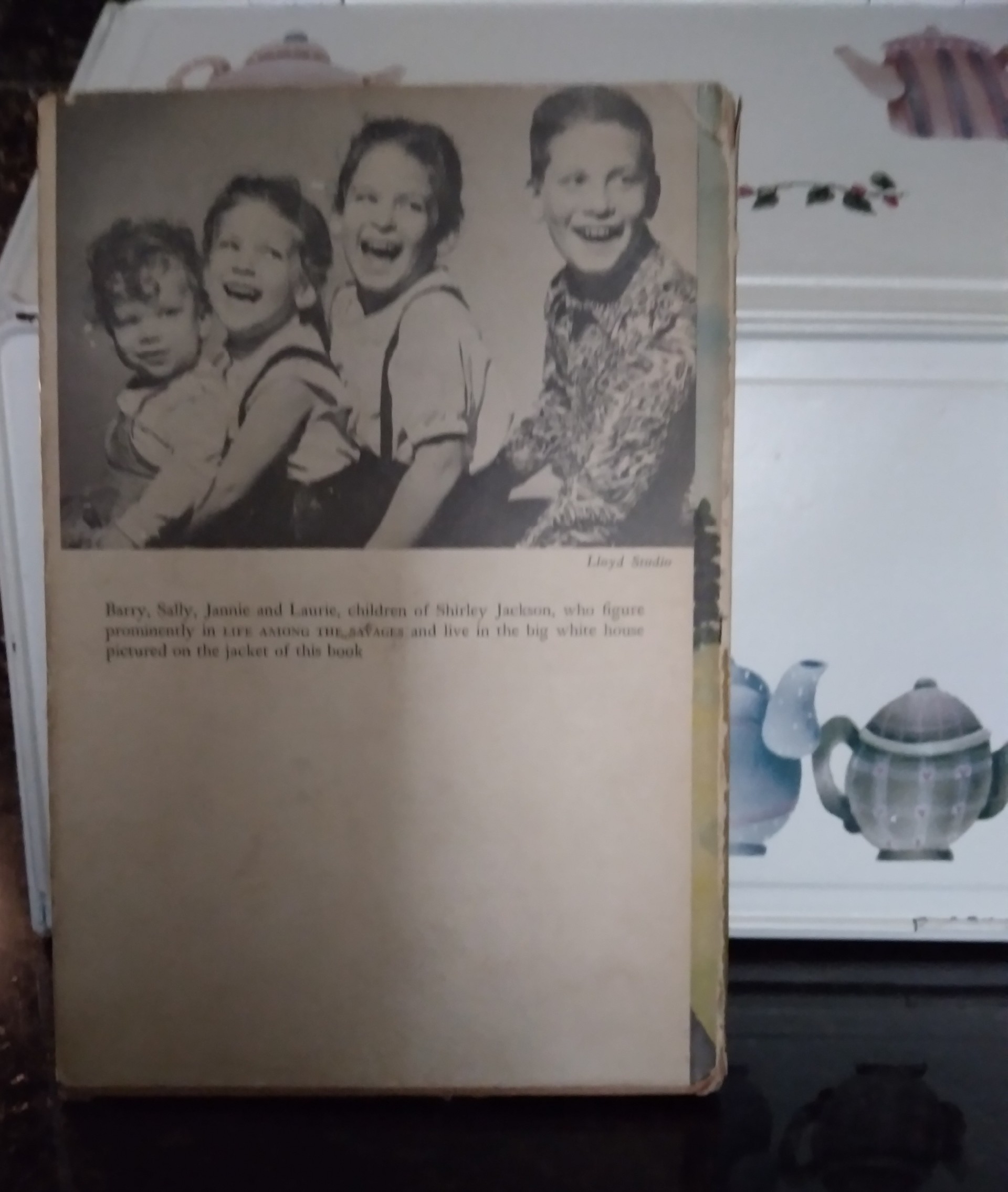
One of Shirley Jackson’s well-known stories, titled “Charles,” is incorporated into Life Among the Savages, and I used that story when I taught middle school language arts as a wonderful example of irony and foreshadowing. If you haven’t read it, you can check that out here! Her children are shown below on the back of the book’s dust jacket. I have since learned that she also wrote a follow-up book called Raising Demons.
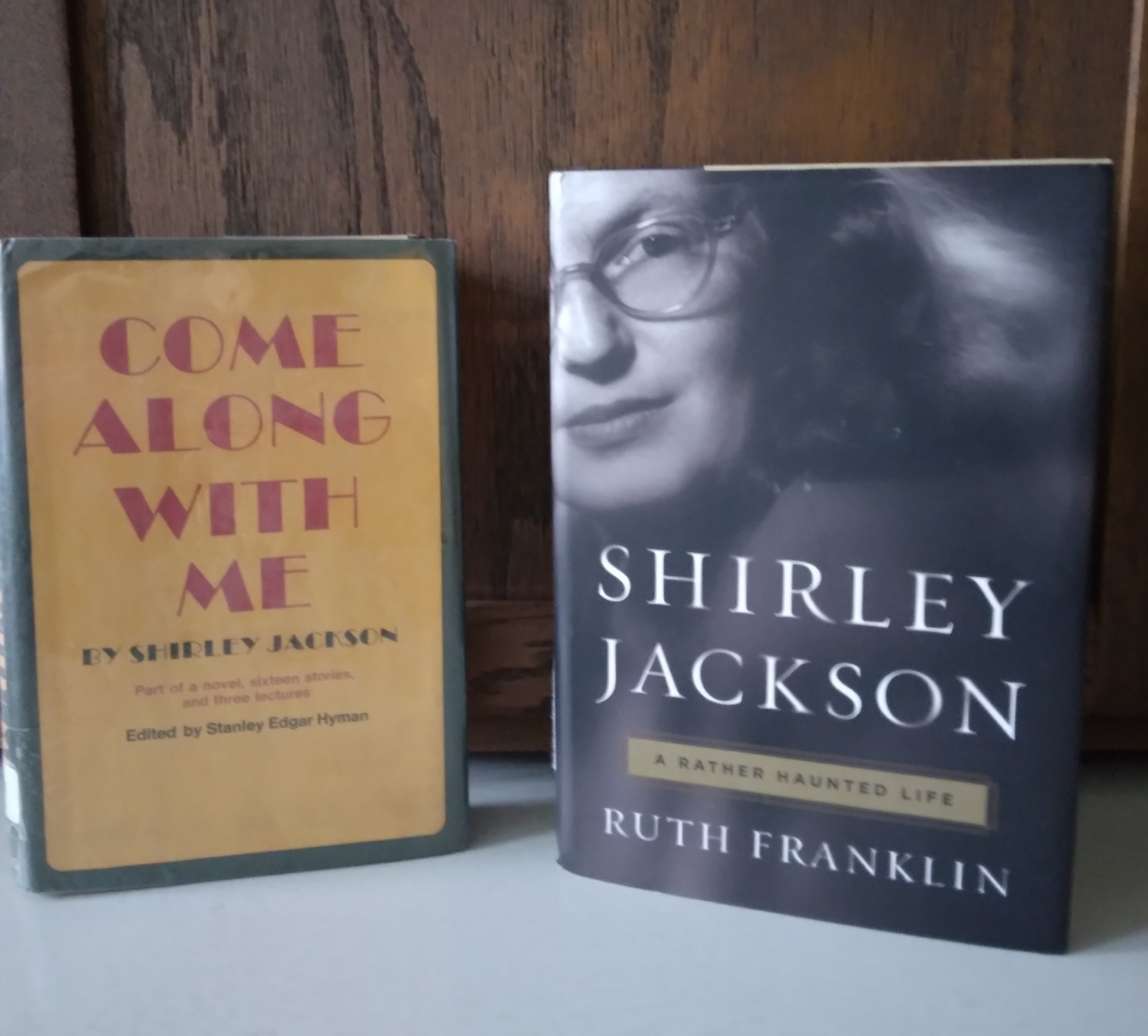
Over the years, I was always on the lookout for anything by Shirley Jackson. One summer, I went to the annual library used book sale in Sault Ste. Marie, Michigan, and was excited to find the book Come Along With Me. Pictured below, it contains lectures about writing, an unfinished novel at her death, and short stories, including “The Lottery.” It was edited by her husband, Stanley Edgar Hyman. What a find! The other book, Shirley Jackson: A Rather Haunted Lifeby Ruth Franklin, is a new, exceptional biography that my sister gave me, knowing my interest in the author. When I reached the last page, I felt that I knew this complex, eccentric, and often misunderstood woman. And I could see how this talented author delved into malice, cruelty, and terror while also skillfully spinning humorous stories about everyday life!
In the past, I’ve had the privilege of rescuing several animals to adopt and save them from an uncertain future. I’ve also rescued plants heading for the compost pile, nurturing them back to health. But a type of mission I’ve accepted that is not as widely appreciated is the literary rescue!
You might ask, “What’s a literary rescue?” First, let’s look at what it is NOT.
As a teenager, I had my first sleepover with a friend I had known since elementary school. We had fun paddling a rowboat around the shallow inland lake across from her house. However, after dinner, we were told that my friend had to put in her hour of daily piano practice. What to do? I wouldn’t attempt the boat alone. And they lived on a country road, so I wouldn’t go walking around. I didn’t want to sit in the living room and stare at her parents (or have them stare at me). My only option seemed to be waiting in her sparsely appointed room. Then what? An hour with nothing to do can seem like an eternity to a teen.
Luckily, I discovered a small shelf filled with books in the corner of her room. These were old books, mostly without dust jackets, to provide clues about their contents. I grabbed one named Claudia because it was a girl’s name and started reading. The story was about a young, recently married woman who was not yet far beyond her teenage years. I was captivated. The sounds of piano music in the background faded away.
When my friend finally returned, I showed her what I’d been reading. She informed me that “all those old books” used to belong to her mother, and the girl didn’t like most of them. I’d started reading one and asked if I could borrow it and finish it later at home. She agreed and wrote her name inside. I thoroughly enjoyed the book. I hated to let it go. Months turned to years. About a decade later, I discovered Claudia was the first book of a charming series by Rose Franken. I’ve now read them all. I meant to return that book to my friend and maybe tell her how much I liked it. However, I never did, and I have now lost track of her. Sorry, Marilyn!
Did I actually “rescue” that book? Probably not. Because I kept it intentionally, some might say it was a “booknapping” rather than a rescue. And I doubt anyone in the family would have burned or thrown those vintage books into the trash anytime soon. But it certainly was a lucky, long-term borrow on my part!
A few years later, the summer I graduated from high school, I donned my bathing suit and walked to the local beach one afternoon. This wasn’t the park where all the teens hung out but a small, quiet affair where parents were more apt to take their little ones. I just wanted to get some sun and fresh air while enjoying the book A Summer Place by Sloan Wilson.
Engrossed in the story, I tuned out the few beachgoers around me and didn’t realize at first that the sun was no longer reemerging from behind the clouds. I finally noticed the chill and the appearance of goosebumps on my bare arms and legs. Deciding I should head home in case rain moved in, I put my book aside in the sand, threw my pop can (yes, we called it pop in Michigan) in the trash, and folded my blanket, stuffing it into my beach bag. I quickly set out for home.
A few blocks in, I realized I’d forgotten to pick up my book! The sky still looked ominous, but I retraced my steps. As I drew closer to the beach, I saw my book was nowhere near where I had left it. But I circled the narrow strip of sand, thinking maybe I had been wrong about the location. And then, I spotted it. A young mother tightly gripped my copy of A Summer Place as she rounded up her raucous bunch of kids to leave. Being the introvert I was (and mostly still am), I didn’t say a word and turned back toward home, feeling disappointed. Okay, I knew how the story ended because I’d seen the movie starring Sandra Dee and Troy Donahue. But I would still check it out from the library sometime to finish reading it.
Had that person “rescued” my book? She might have thought so (hello, woman from the beach; I hope you enjoyed it!). But I went back for my book to protect it from the elements, so I say it doesn’t qualify as an actual rescue on her part.
Years later, when I was teaching fourth grade in Michigan’s Upper Peninsula, an elementary school in a nearby county closed down. Their entire library of books was up for grabs. Many of them were brought to our school for teachers to select for their classrooms. Of course, many were old copies of familiar chapter books, such as those by Beverly Cleary. But they certainly added to this new teacher’s classroom library. My heartbeat raced when I saw two picture books by Swedish author and illustrator Maj Lindman. Her bright “Flicka, Ricka, Dicka” and “Snipp, Snapp, Snurr” series about two sets of triplets were my favorites as a child and the first ones I looked for at the library. Although the characters might have looked a bit younger than fourth grade, I would enjoy showing my students examples of books I had loved as a child. I grabbed one from each series.
When I moved away and left my job at that school, I dreaded leaving those books behind. I imagined the new fourth-grade teacher dumping anything outdated or what they considered overly young. I took the two picture books with me to share with my next group of students. Stealing? Not really, although I could have asked permission. I still have them with the old library cards tucked inside. A literary rescue? I like to think so!
Even after moving away, I often returned to Michigan’s Upper Peninsula. Hunting for used bookstores was a favorite summertime hobby. One year, I saw a sign that said, “Books in the Barn,” pointing down a dirt lane. Sure enough, there was an old barn full of used books! And this was not a barn fixed up to serve as a store. It was still just an old barn, open to the elements, daylight showing between the boards. The books all smelled somewhat musty. A friendly clerk said they had somehow ended up with the inventory but didn’t have an appropriate shop space. They would sell what they could that summer and get rid of the rest. The words “get rid of” rang in my ears. I bought several books that day. The ones that stuck in my mind were Jack Finney’s time travel duo Time and Again and From Time to Time. They were both warped from the humidity. But I enjoyed them immensely and didn’t give them up until years later during another move. Was this a literary rescue? Yes, I believe those purchases do qualify.
So, we could say the following conditions constitute a literary rescue: saving books that are in danger of being burned, drowned, thrown away, or otherwise ruined by the elements.
This brings me to a recent rescue event. Last autumn, I visited the library in the late afternoon. The air was warm, the breeze light, and the clear sky a bright blue. They keep the building very cold inside, so I wore a thin fleece. I had to return a few books, and the distance is just the right length for my daily walks. I began browsing the shelves with the new titles and eventually glanced up and outside. What? Leaves and branches flew past the windows, and the sky was unusually dark for that time of the day. I looked at my phone and saw the temperature had already dropped about 25 degrees. I checked out the book I’d found and headed for the door.
Outside, the cold wind hit me with force, and I was glad I’d worn the fleece, which at least offered minimal protection. ABlue Norther, I thought. One side of the sky had turned a much darker blue, and a solid curtain of steely gray clouds was moving in from the Northwest. This would not be one of those dry Blue Northers; rain was coming. I had forgotten to bring a bag with me. If rain started to fall, I’d have to put the book under my jacket. I quickly strode toward home.
My next mistake was the route I took. Yes, it was the most logical way to go. But I had to pass the corner where a Little Free Library was perched on my way. I often check that wooden stand for books on my walks and have made great finds. But the door was broken, yet again. Repeated repairs had failed. It kept breaking or falling off. That day, I didn’t want to look and tried to stay on the other side of the street. But it seemed as if someone had just added a collection of books. I didn’t need anything else to carry since I was only halfway home, and rain was imminent. But…I couldn’t help myself. I hurriedly rifled through the books. Don’t need, no, don’t need, no. Then, I saw it. A lovely vintage book of poetry by Henry Wadsworth Longfellow. Dark blue with gold and red trim. The pages were edged in gold. I opened it and sniffed. Ahh. I love the smell of old books. It was not in good shape and starting to fall apart. But could I leave it there to be ruined in the deluge? No.
I reached my apartment building just as the rain began to fall. Whew. It was then time to explore my literary rescue!
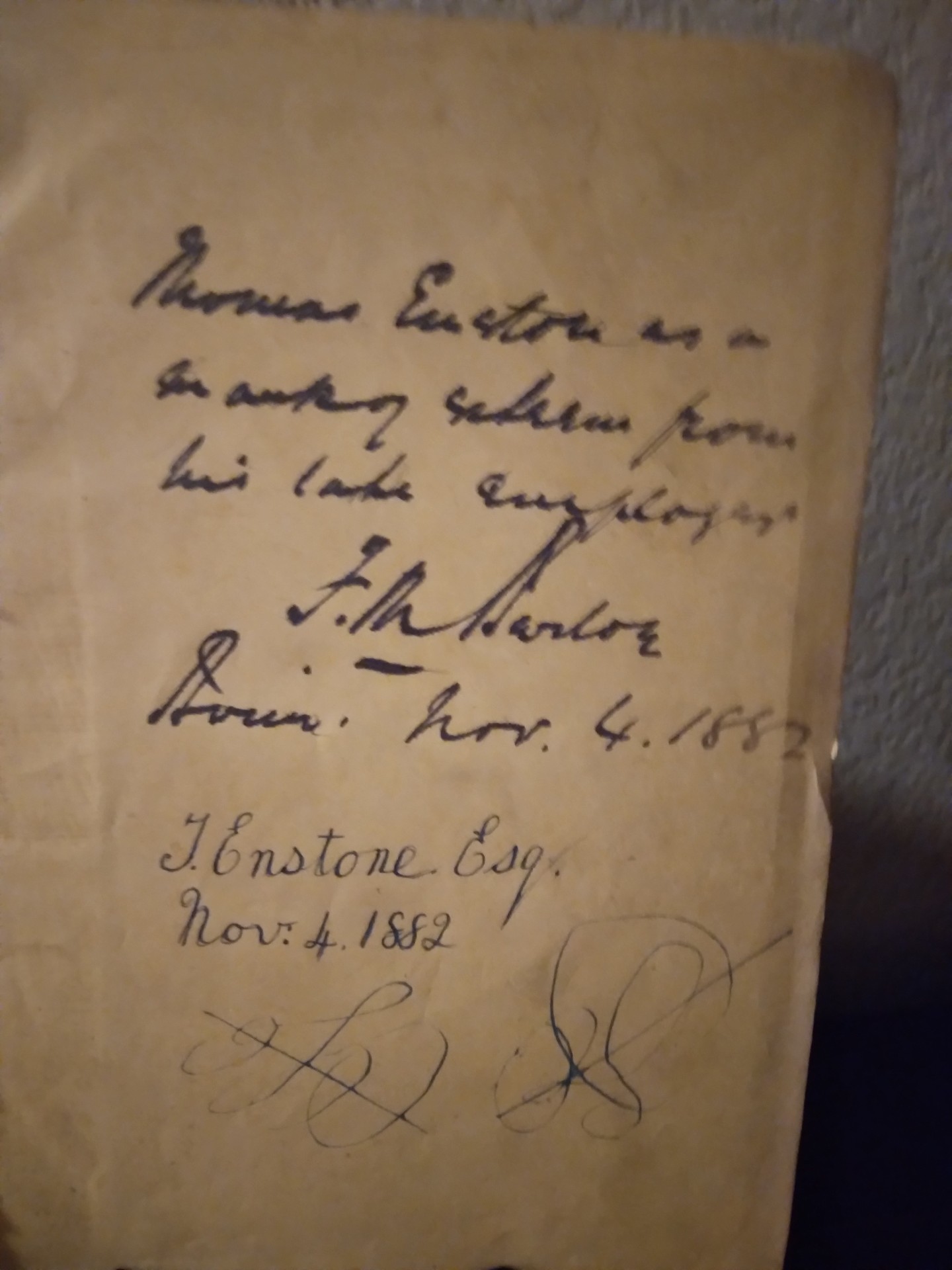
The book’s copyright date is 1882, inscribed by what looks to be F.M. Harlow to a late employee or employer, Thomas Enstone, that same year. The handwriting is difficult to read. Some poems are illustrated, such as “The Village Blacksmith.” Of course, the book sleuth in me was curious to know why a person might give this book to someone with whom they’d worked. What kind of business?
I’ve done some internet research at several points, trying to find out more about these individuals or a possible connection between them and the author. I found that Longfellow’s nephew worked with an architect named Alfred Harlow. In addition, there was a Louis Harlow, who illustrated some of Longfellow’s books. So, maybe the Harlows were related? That’s all I’ve come up with so far, but it’s fun to look! If you have any ideas, I’m interested!
Since that day, the door to the Little Free Library has come apart and been fixed several more times. But people continued to put books in there. I brought home several, although those were more contemporary. My apartment’s bookshelf space is limited, so I’ll either need to donate more of my books to the library’s little bookshop or give up literary rescues altogether!
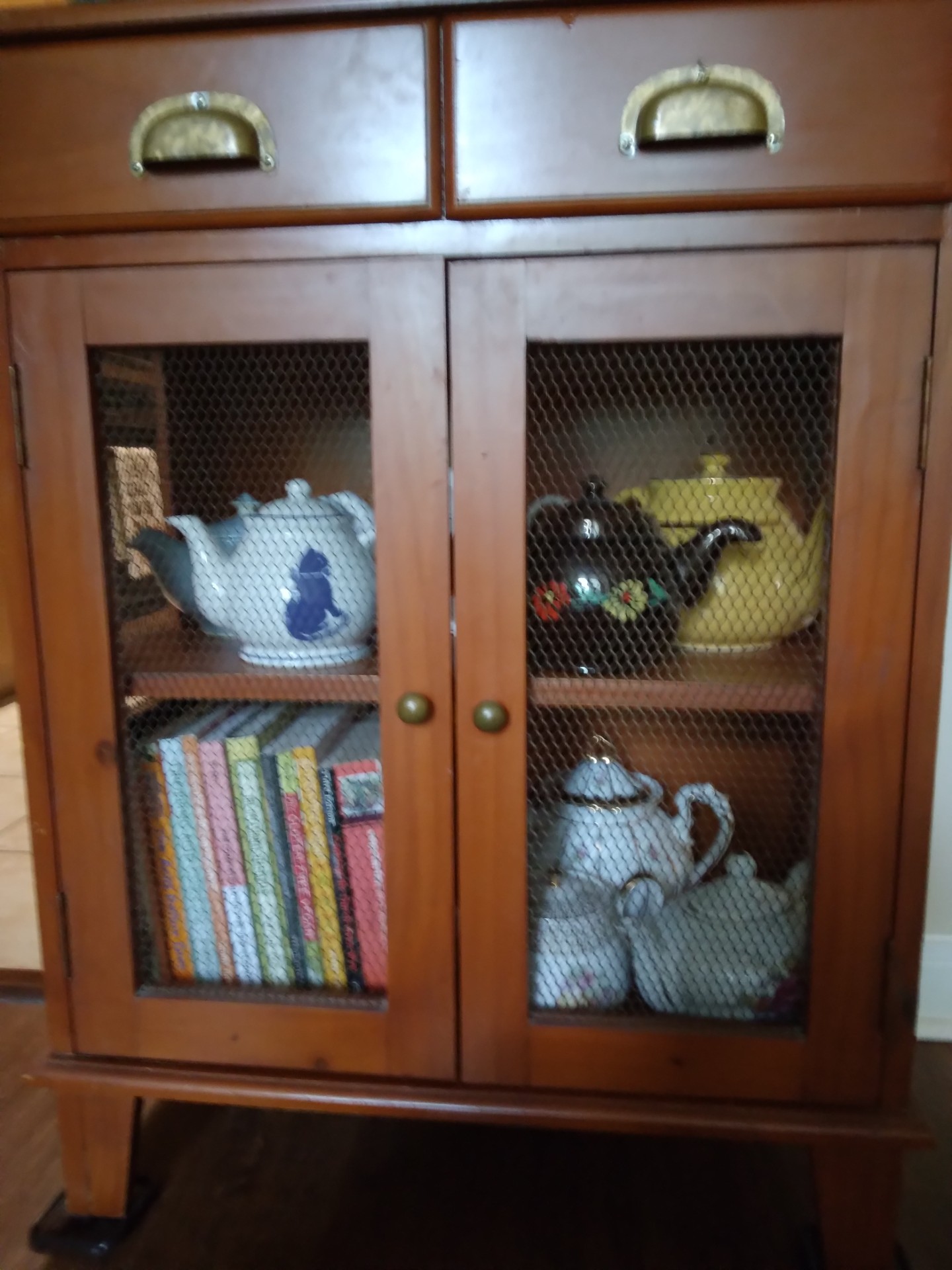
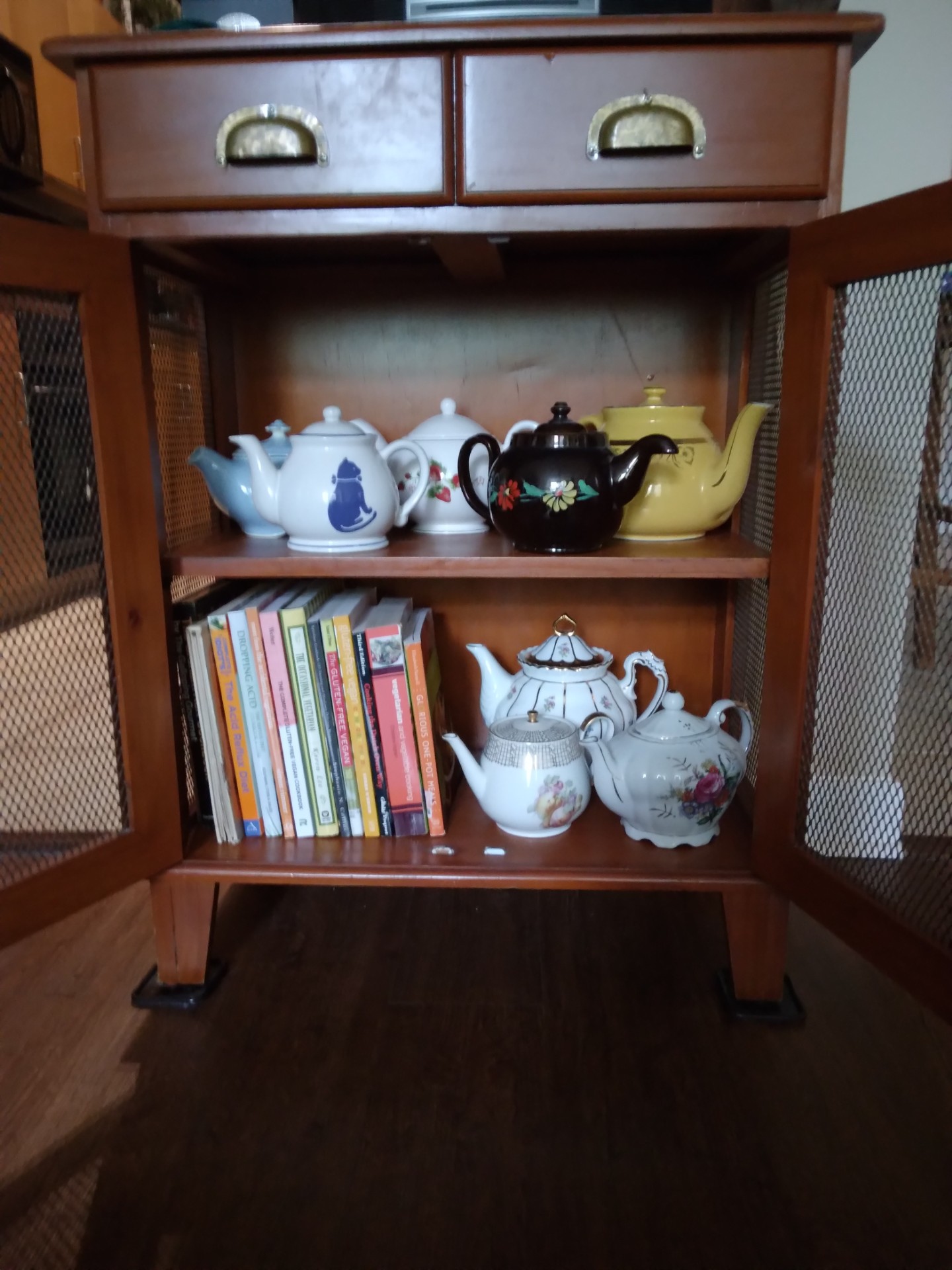
Although I look forward to my morning coffee and one extra cup in the afternoon, I also enjoy tea. My favorites include ginger, chai, and fruit teas. I love teapots and have collected several over the years. These came from grandmothers, an aunt, a former mother-in-law, a friend, and a special purchase to match a planned kitchen renovation. One of them even incorporates a music box with the tune of “Tea for Two!”
The two pots on the top right are my most treasured. The yellow/gold one came from my maternal grandmother. The brown pot with red and yellow flowers is from my paternal grandmother, who used to make cambric tea for the kids. That’s just milk, hot water, sugar, and a hint of tea, but it made me feel very grown-up.
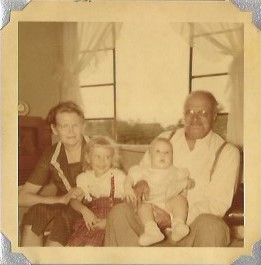
In the photos below, my maternal grandmother is pictured in California with her china cabinet off to the right. The yellow/gold teapot rests on the middle shelf. In the other photo, baby Becky and my sister, Terri, spend some time with our paternal grandparents at their home in Michigan.
I don’t often make my tea in a pot and tend to just steep my teabag in a cup. But I love having these vintage teapots to give me a cozy feeling of continuity. I keep the pictures of my grandmothers right inside the pots so my daughters will have no doubt of their importance!
When I came across this cute vintage paperback by Betty MacDonald at the used bookstore, I recognized the author’s name right away. But this was a “new” story and a new husband! The $3.00 price tag was well worth it, and I snapped this one up without a second thought.
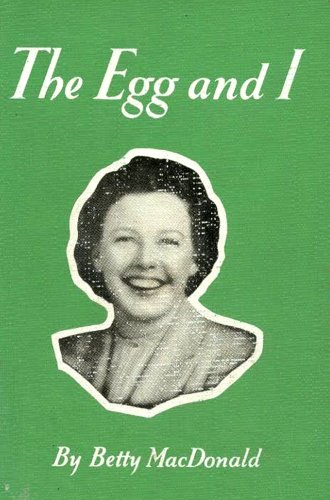
I became familiar with Betty MacDonald’s humorous writing through her first book, The Egg and I, years ago, in high school. I was one of the students chosen in my senior English class to take part in a regional forensics competition. Assigned to do humorous readings (not sure why), I had no clue what to present. The Egg and I had rested on my parents’ bookshelf for years without tempting me. It no longer had the dust jacket pictured below, and with just a plain green cover, it never called to me.
My mom wisely suggested I check it out for some humorous chapters. I thoroughly enjoyed the funny book about a newly married couple who lived on a chicken ranch in Washington State. Imagine my surprise when I discovered this was the origin of the Ma and Pa Kettle characters I had seen in movies! I did well in the competition, advancing several rounds, and even had to read in front of my entire (small) school at an assembly. I was very nervous, but Betty MacDonald’s entertaining words gave me much-needed confidence.
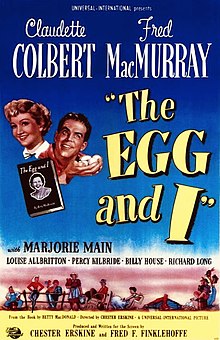
Years later, I enjoyed watching the movie on either AMC or TCM. Claudette Colbert played Betty, and Fred MacMurray played her first husband, Bob.
When I came across Onions in the Stew, I realized there was a lot more to Betty MacDonald (1907-1958) than I had ever known, and I needed to dig deeper! I soon discovered that she wrote Anybody Can Do Anythingabout raising her daughters as a single parent during the Depression and also The Plague and I about surviving tuberculosis. All told through humor, of course. Onions in the Stew tells about moving to Vashon Island in the Pacific Northwest’s Puget Sound with her two daughters and new husband, Don. For a taste of the humor, I’ll mention that their washing machine floats away into the Sound their first night there!
Although Betty MacDonald died much too young, from cancer at age 49, she packed a lot of living and writing into her life. She is also the author of the Mrs. Piggle Wiggleseries, in addition to Nancy and Plum.
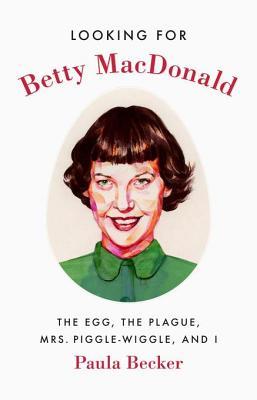
My research prompted by this fantastic find at the bookstore also placed another book in my sights, this biography by Paula Becker. I can hardly wait!
As a child, I loved going to the library. And I definitely looked for my favorites each time we visited. But for the books we bought at the store to keep at home,Little Golden Books were the stories that made my heart sing! In fact, I loved them so much that I still collect them. The three pictured above are titles from my collection that I remember from childhood.
I grew up in a small town, so we had no bookstores or large department stores. The great thing about Little Golden Books, besides their affordable price of just a quarter, was that they were sold in grocery stores and at the local “dime store.”
Although I didn’t yet pay much attention to the illustrator or author names as a youngster, I eventually realized that I was drawn to the books illustrated by Eloise Wilkin. Her characters always wore such soft and friendly faces, as the three covers shown above.
And I also loved the Little Golden Book stories written by Margaret Wise Brown. Yes, the same author of Goodnight Moon fame!
Although my 1946 copy isn’t in very good shape, I’m proud to say that my oldest Little Golden Book, The Little Taxi That Hurried, was written by Lucy Sprague Mitchell , a child education reformer. And it’s illustrated by Tibor Gergely, whose artwork graced many other Little Golden Books, as well.
Later, in the 1970s, my own kids liked many of the Little Golden Books, too! The Monster at the end of this Bookwas one of their favorites. By that time, the price had gone up to $.89.
My family members know that I still love these books and help me add to my collection, on occasion. Above is a Little Golden Book I received last Christmas from my sister. We used to watch Roy Rogers and Dale Evans on TV when we were kids.
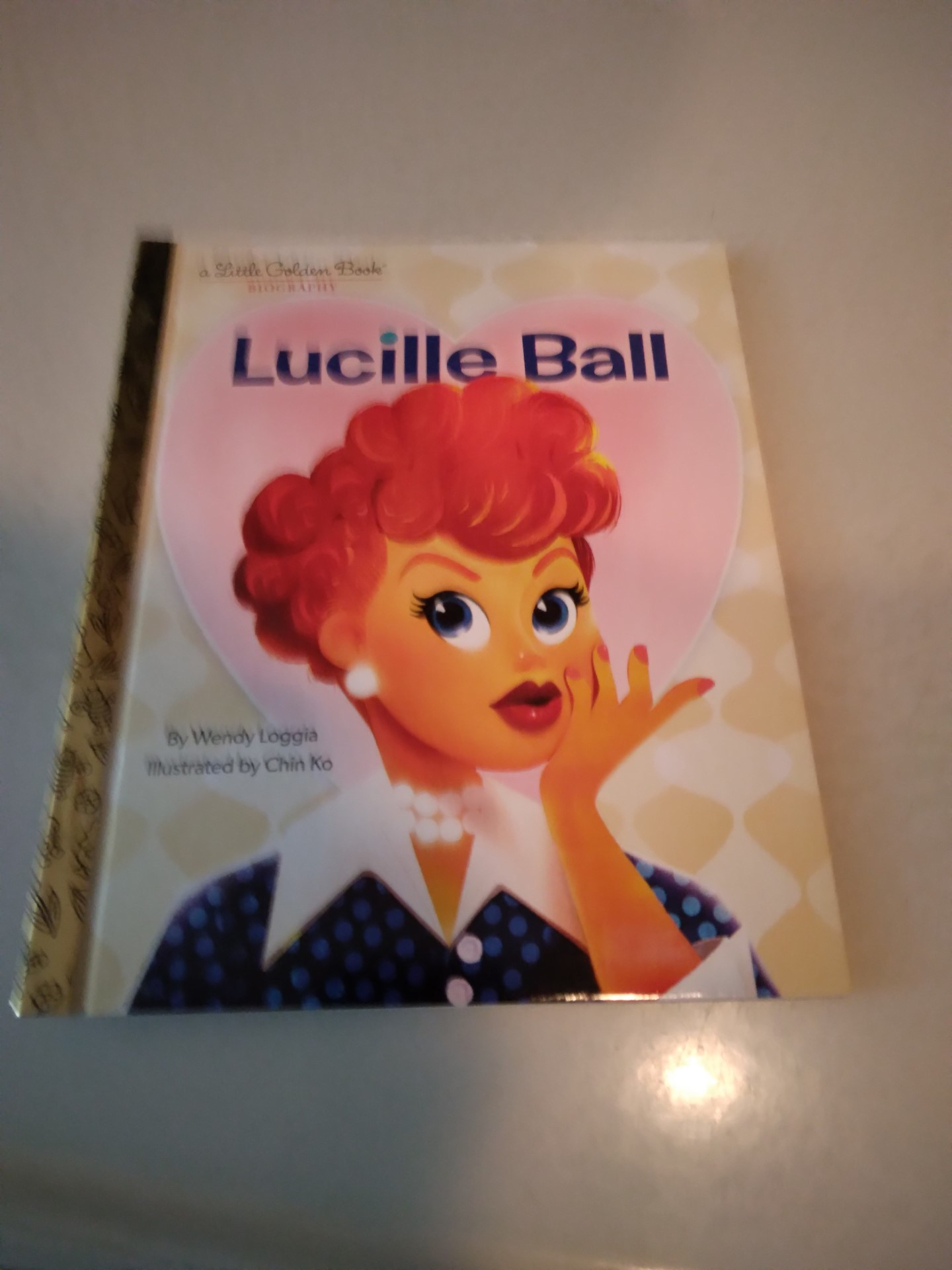
And this is the most recent addition to my collection from one of my daughters, purchased right at Target. Both my girls and I “love Lucy” and have watched many episodes together over the years!
What about you? Are you a collector? Do you have a favorite memory of a Little Golden Book?
Beyond picture books, my next fondest memories of reading as a child were of the Trixie Belden mysteries. And I have my older sister, Terri, to thank for my love of books! She often read to me when we were kids, and she still tells me about great series she has heard about or read that I might want to try.
Although I enjoyed Nancy Drew’s antics, Trixie was always my favorite and seemed more like a “real kid.” I still have several treasured copies of Trixie Belden books from our childhood.
If you also loved those books or would like to learn more about them, here is a great article with background about the settings and authors!
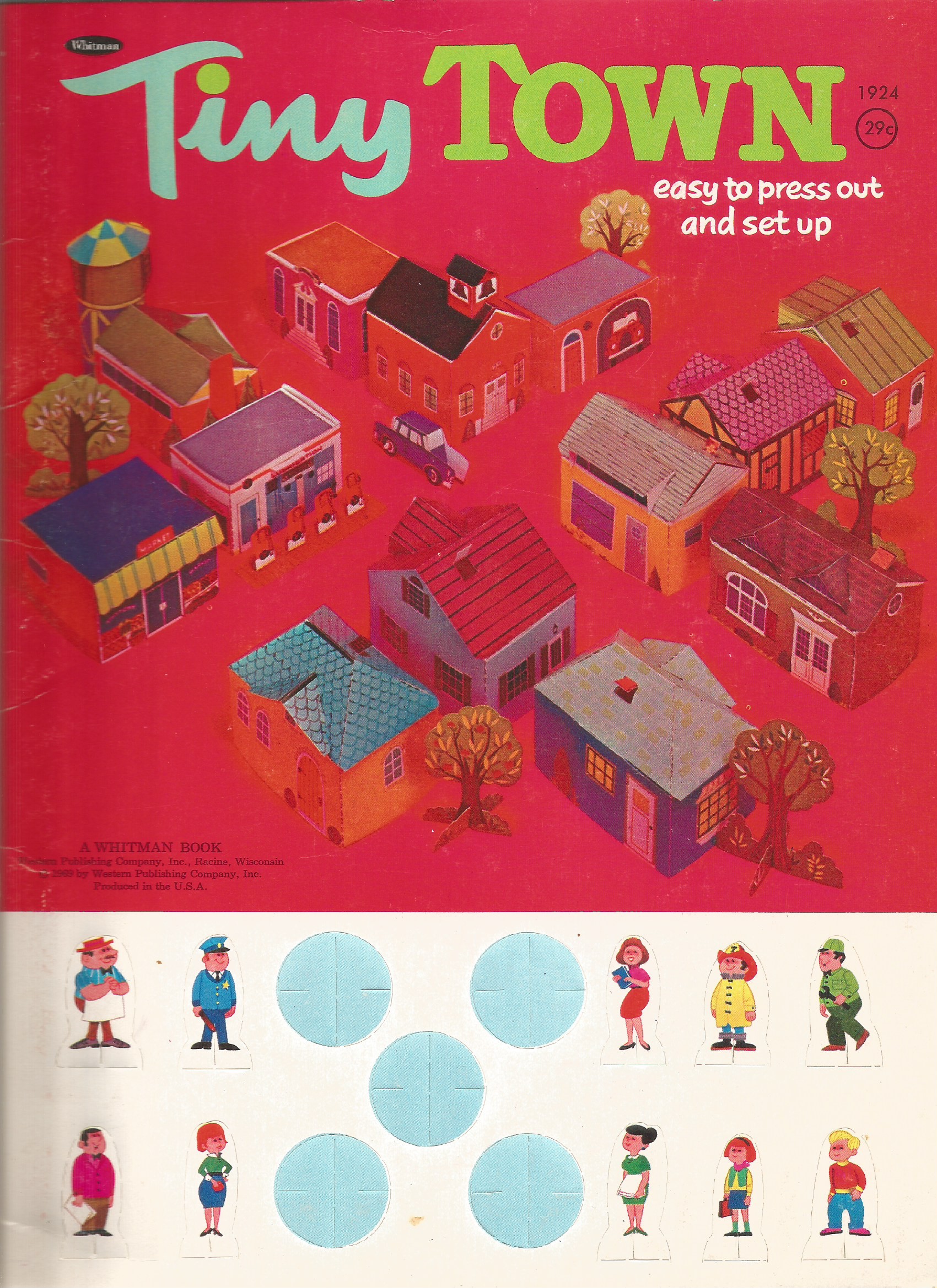
Bookstore, used bookstore, used bookstore with ephemera. Good, better, best! I love those used bookstores that carry all sorts of “doo-dads,” and I was ecstatic the day I found this “Tiny Town” punch-out book!
This one is from 1969 when I was already in my teens. But punch-out books were very popular when I was much younger. I have fond memories of pressing out and putting together a castle one time and a giant treehouse another, both on our old card table that looked a lot like the one pictured below.
Although not nearly as challenging as today’s Lego creations, these cardboard activity books offered plenty of fun to punch out the pieces, decide how they all fit together, and then play with the finished product. I’m sure that my older sister, Terri, was our “project director,” since I wasn’t overly patient. I remember lots of tape being involved!
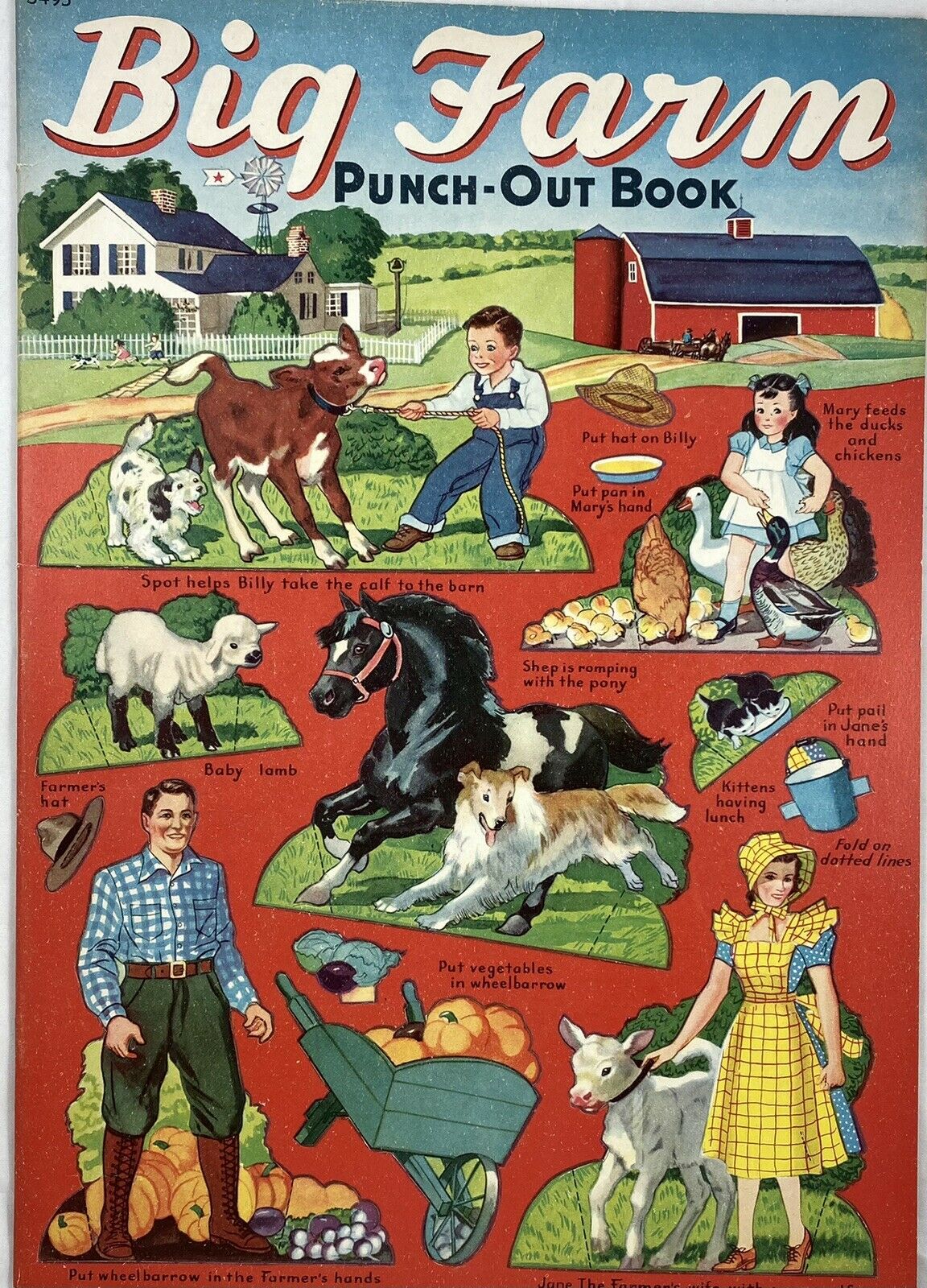
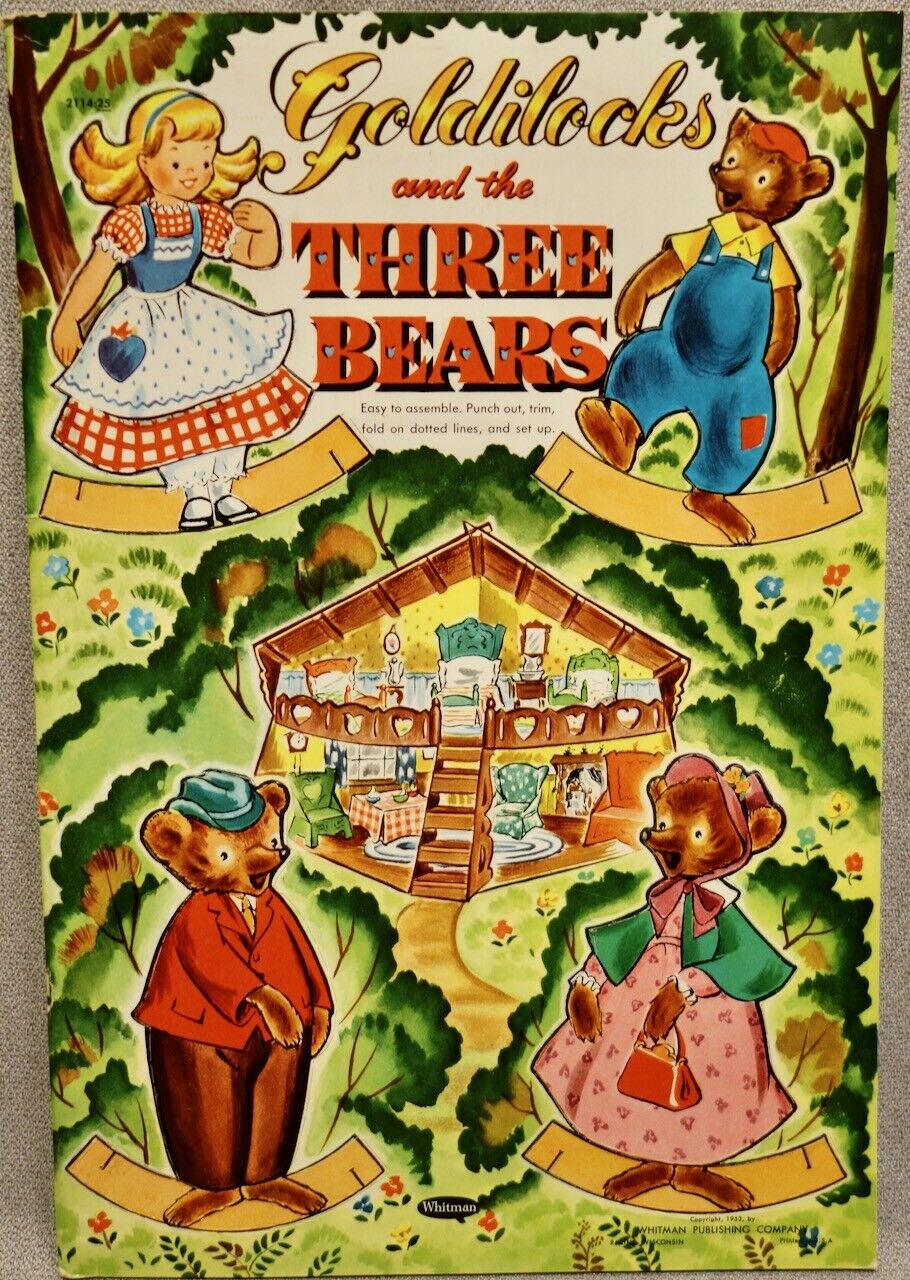
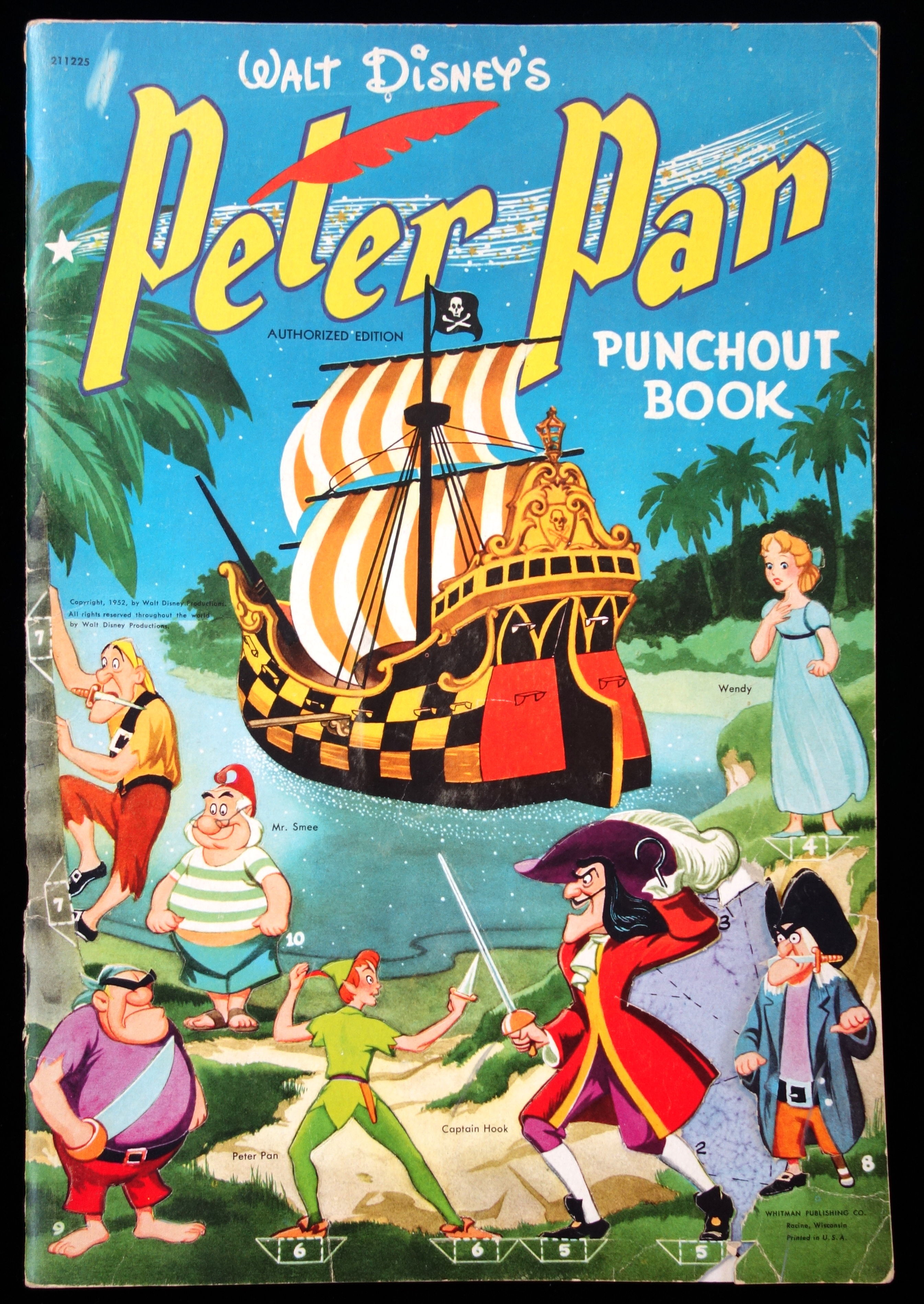
Wikipedia says these books first appeared in the 1930s and that most were published, as this one was, by Whitman Publishing of Racine, Wisconsin. Many of them were based on televisions shows or movies. Maybe you remember these from your childhood, as well? Here are a few other examples found online. Hope you enjoy looking!
House Built around 1900 in Michigan’s Upper Peninsula
In a prior post, I wrote about finding a recipe notebook from the past behind a drawer in the kitchen of the house pictured above. That was only one of the vintage literary surprises this house held!
Thanks to Nona Blyth Cloud at wordcloud9 – Flowers for Socrates, I learned that today, July 30, is International Paperback Book Day. An early version of Penguin Books started publishing and mass marketing classics in paperback format on this day in 1935. This meant that more people could afford to buy books, which was certainly a wonderful thing.
As readers of my blog know, I enjoy collecting vintage titles. This topic inspired me to think about my own books. What is my oldest paperback book, I wondered. Then I was off to search my shelves. After checking out my lovely finds (sniffing and leafing through a few pages while I was at it), I proved what I had thought to be true. My paperback book dated the very earliest, 1891, was the one found in the attic of the house pictured, above!
The book is titled Married for Money and is written by May Agnes Fleming. This was such an exciting find, I remember, especially since nothing else very interesting was found up there in the attic. After I finished with my happy dance that day, I began to dig deeper and find out more!
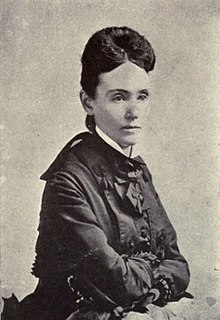
Turns out that “Mrs. May Agnes Fleming,” as the book cover states, was Canada’s first best-selling novelist. In all, she wrote 42 “women’s dime novels,” and 27 of them were published after she died, which is true of my title.
May Agnes Fleming, 1840-1880
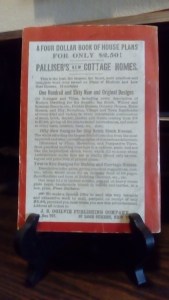
Offer on Back of Book; 160 House Plans for $2.50
Ad for Teething Syrup inside Book
My research also revealed The American Women’s Dime Novel Project! What began as research for a dissertation eventually turned into a website with information about these books written for working-class women, from 1870 to 1920. This interesting site offers articles, additional resources, author biographies, images, and even some of these novels turned into e-books!
Although they’re called “dime novels,” my particular book was marked “25 cents.” Inflation, I suppose? If you’re interested in the history of women’s literature, please be sure to check out this fun and informative website! ~Becky
As my regular readers already know, I adore bookstores, especially those that feature used books! To put an even finer point on that, I love the shops that carry other various types of vintage items, such as maps, magazines, product leaflets, branded recipe booklets, and the like.
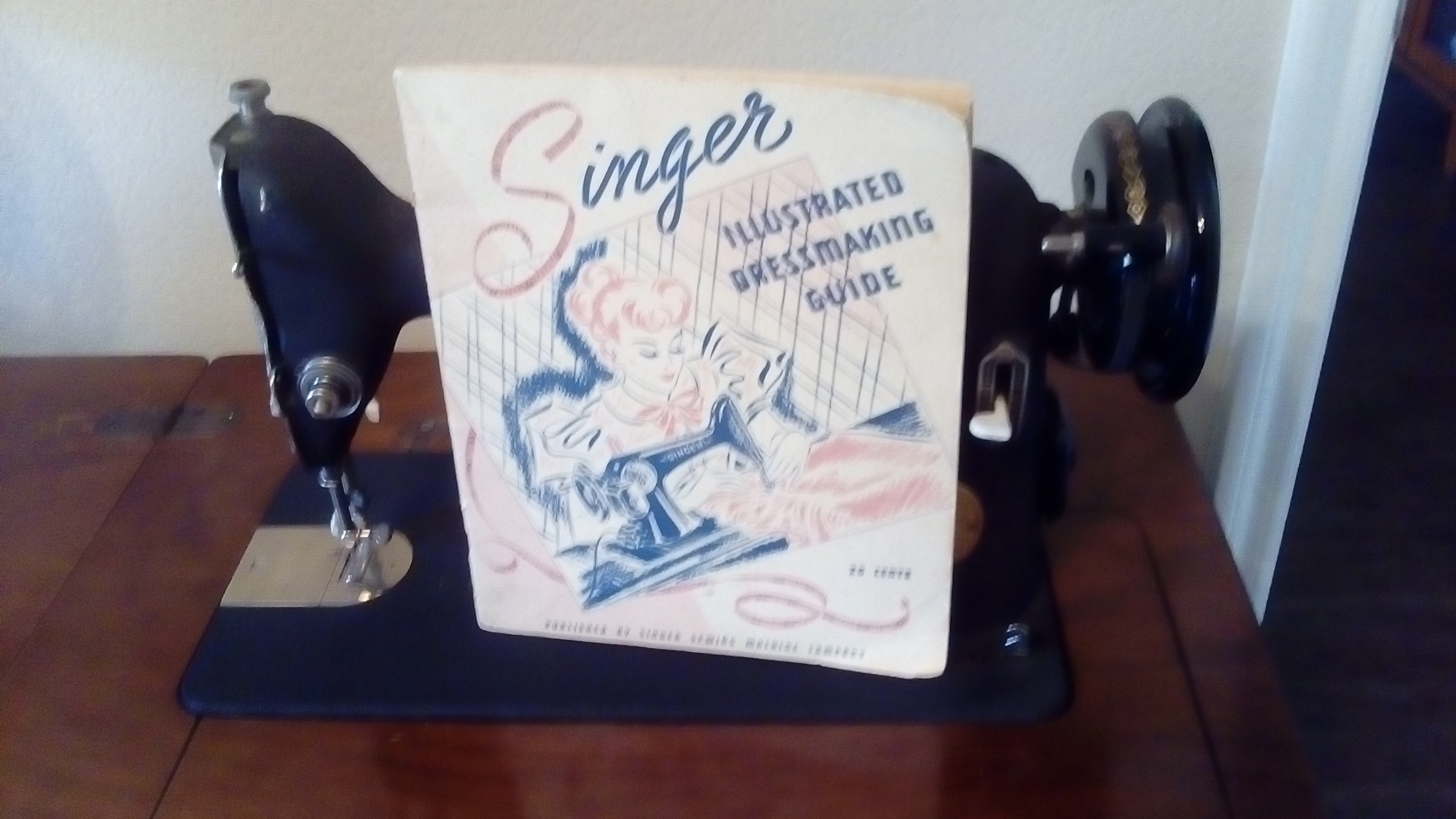
One of my favorite such spots is located in Moran, Michigan, called “The First Edition, Too.” It was there where I was thrilled to come across the 1939 Singer Illustrated Dressmaking Guide pictured above. This was especially fitting, since I sewed as a teenager in Michigan on my mother’s Singer, which now “lives” in my Texas apartment. The slim booklet shows drawings of sewing strategies such as shirring, insets, and pleats. There are even sections all about sewing for infants and making “first school dresses.”
Martha Kennedy, who blogs at “I’m a Writer, Yes, IAm,” wrote a great post about her grandmother’s sewing machine. This got me thinking more about my own, shown above! Martha’s appears to be older and much more ornate than mine, as a treadle machine compared to my electric model. As you can see, I still have the original box with attachments.
I found an interesting website for theInternational Sewing Machine Collectors’ Society (ISMACS), where I zeroed in on some info about my machine. Based on the serial number, mine is a Singer series AH model and probably purchased about 1947-48. This makes perfect sense, as that would be around the time my mom had her first baby, my older sister, Terri. She may have sewn her infant layette on that machine!
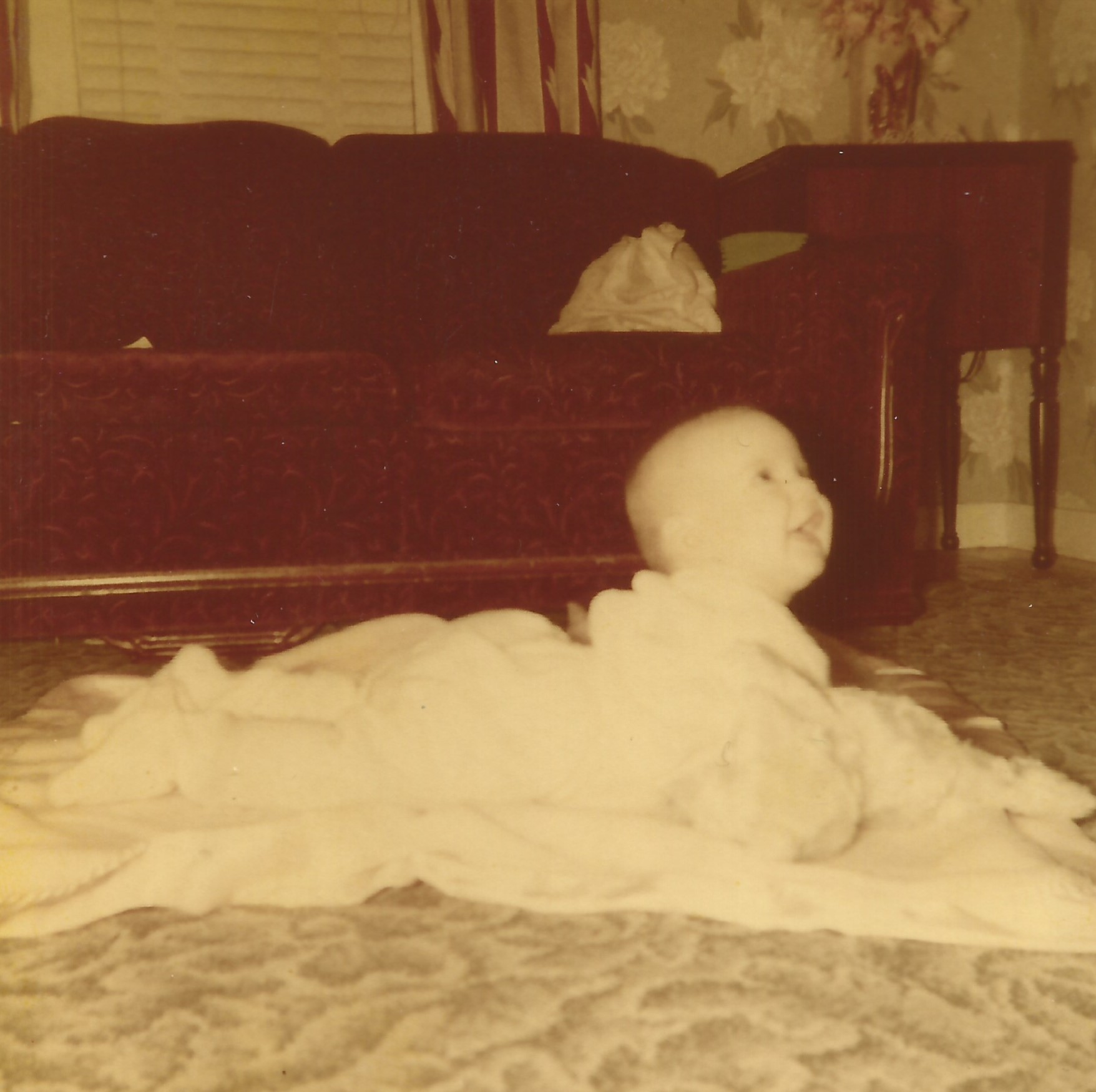
Looking through old pictures, I was pleased to find one from when I was about six months old. My mother’s Singer sets next to the couch behind me. Although Mom sewed quite a bit when her kids were young…clothing, doll clothes, and items for the household…I think she used it mainly just for mending in later years. I’m sure happy my mother hung onto this machine, since it brings back such sweet memories for me.
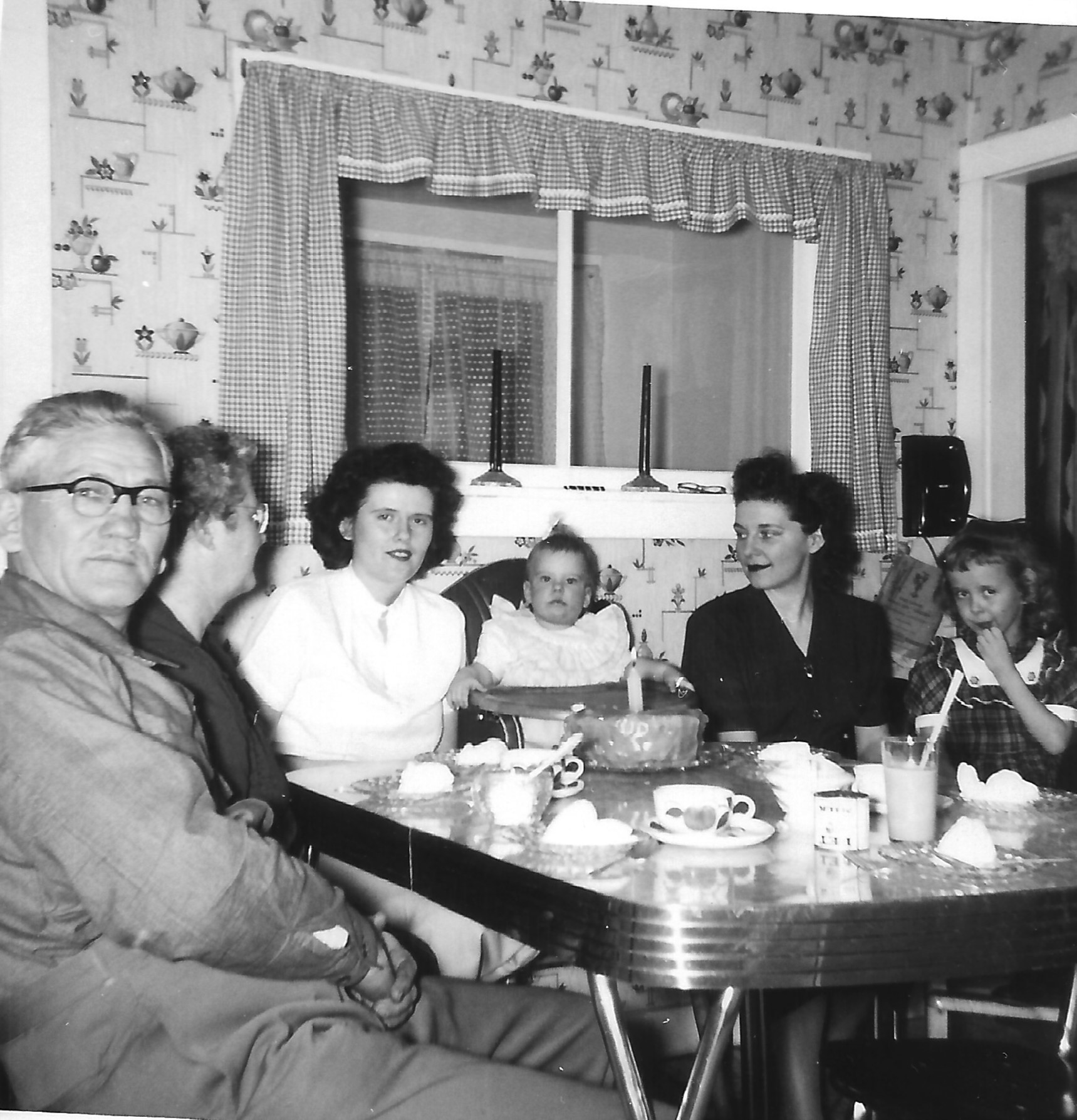
In honor of Mother’s Day, I’ll share one more photo, showing my maternal grandparents (Rudolf & Frieda Witzke), Mom (Ella Witzke Ross), Aunt Frieda (Mom’s older sister), and my older sister, Terri. This photo was taken in Tawas City, Michigan, on my 1st birthday, and I imagine my father, Philip Ross, was the man behind the camera. Now I’m wondering if Mom sewed those cute, gingham kitchen curtains on her Singer!
Written by Jessica Potter Broderick and Illustrated by Jean Tamburine
Home food delivery from grocery stores and through a variety of home meal services has made a resurgence in the last few years. With the current needs for social distancing and quarantines related to the coronavirus, this practice will likely become even more common.
From my childhood in Tawas City, Michigan, during the 50s and 60s, I have a clear memory of our milkman from the local dairy, Nelkie’s. He was a handsome, dark-haired chap named Tony, who wore some type of white jacket or uniform. I don’t remember his vehicle, however. In my mind’s eye, I can still see several glass bottles of milk set into the frosty snow on the top step near our front door.
Time went by, and one day I realized that Tony the milkman had disappeared. The dairy remained, but home delivery must have been suspended. Evidently that was common for the times, as mentioned in this interesting articleabout the history of home milk delivery. Yet another nostalgic piece of our past that no longer exists.
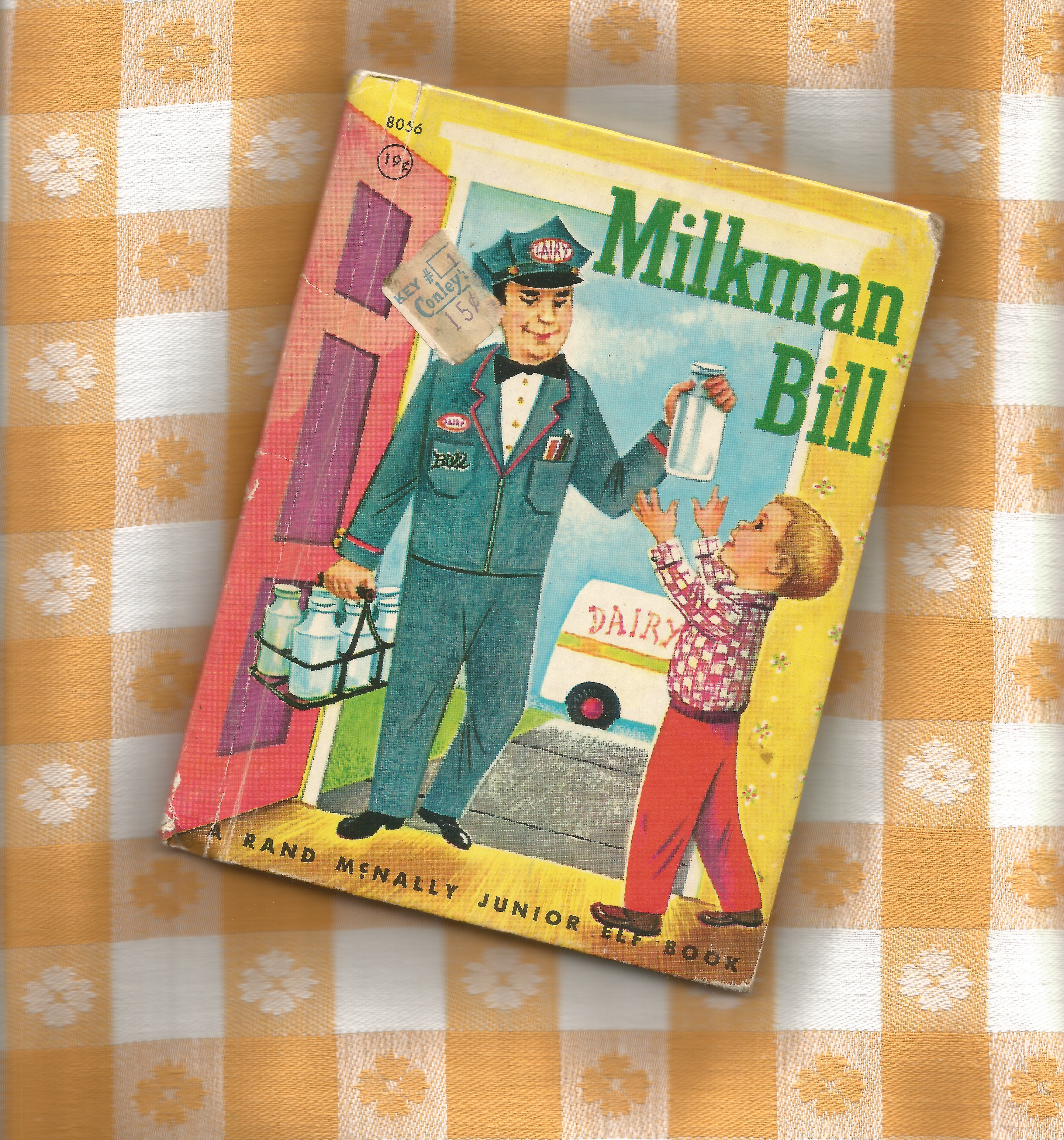
Some people collect LittleGolden Books, while others seek the Junior Elf Books. I love both and often look for them when I visit used bookstores. When I saw the Junior Elf Book pictured above, Milkman Bill,it brought back so many childhood memories and sensations. Surely you can see why it was a necessary purchase? The original price tag still stuck to the cover says 15 cents. I paid a bit more, but it was certainly reasonable at $1.00.
The story centers on a little boy, Dickie, who’s been sick in bed for three weeks. The doctor has told Mother that Dickie must drink more milk to get better and stay strong. If only staying healthy was really that easy! Dickie has many questions for the milkman, and the reader learns about the entire process, from cow to home. The book ends with Milkman Bill promising Dickie and his family a tour of the dairy the following week. This slim volume, published in 1960, smells exactly the way an old book should!















 Platform Number 4