Thankful for…my critique group!

Amid troubles far and wide, reaching for positives as a lead-in to the coming holiday season feels like a wise course of action. Beyond the importance of family, health, and meaningful work, I’m drawn to reflecting upon my writing critique group. Most of us met through a larger local organization where we occasionally share our works and also enjoy monthly presentations on writing craft. However, several of us longed for a smaller group where we would share our work more regularly. So, about a half-dozen years ago, our small critique group of six was born. Twice a month, we meet in a study room at the Frisco, TX, library. We made it through the pandemic online but were happy to resume meeting in person.

Critique groups come in all shapes and sizes; the group I belong to is no exception. Our members write fiction for adults and children, nonfiction, novels, novellas, short stories, blog posts, and newsletters. We are both traditionally and self-published. Our process is simple. About four days before each scheduled meeting, we email our writing pieces to all members. Those members then read and offer praise, observations, questions, and suggested edits, then return the marked documents to the authors.

At our meetings, we discuss all the feedback as a group. In addition, we also talk about other things: publishing options, querying, what we’re reading, our research, and sometimes our personal lives. I’m happy to say we’re supportive not only as writing peers but as friends. Thank you: Linda Baten Johnson, Carolyn Lis, Gary Thornberry, Jan Angelley Cobb, and Donna Anderson. And also a note of appreciation to Karen Hodges, our former member who moved away with family. My writing has grown with your help. I’m grateful for each of you!

If you crave a successful critique group, various sites offer informative articles to assist your efforts. The Jane Friedman website tells how to “Find the Right Critique Group or Partner for You.” And after you’ve found your group or partner, the Writers in the Storm blog suggests “How to be a Good Critique Group Partner.”

I’d love to know about your experience with a critique group or partner! What didn’t work, and what DOES work for you?

As the following photo reminds us, interesting writing topics can appear in the most unexpected places!

Take care, Becky

Sault Ste. Marie, Michigan

Plants and Publication!

Becky’s Balcony Mid-May

Happily, my balcony garden is growing well, especially that huge tomato plant! The trick here in Texas seems to be starting plenty early (mid-March) so the plants are well established before the overwhelming hot weather hits. I already have lots of little green cherry tomatoes. I enjoy reading out here!

I’m also pleased to report that my story “Shelf Life” now appears in the 7th edition of the U.P Reader (Modern History Press). In this twisted tale of revenge, a woman discovers some shocking news and proceeds to serve an unusual recipe to guests! I’ll have to wait a while to share that one with you. Meanwhile, I hope you’ll enjoy my story below, which was published last year and features a very different type of meal.

Dinner for Two

by Becky Ross Michael

Built at the advent of the twentieth century, the proud house on Tamarack Street keeps watch over the neighborhood. With a facelift of white paint and new porches, the home embraces the whispers, laughter, and tears of those who came before. Tulips and daffodils reappear like clockwork each spring, and perennial flower beds rebloom every summer. Each autumn, the maple leaves let go of life and flutter to the ground. And the inevitable snows blanket the dormant lawn and insulate the foundation every winter.

Within the walls, modern updates conceal remnants of faded papers in floral prints and musty wooden lath. Residues of past colognes and stale cooking aromas occasionally escape into the air to puzzle the present-day residents.

***

In the kitchen, snowflakes swirl beyond the windows as the man carefully constructs a multi-layered vegetable dish. No meat or dairy, as a nod to her favored eating trends. Together, they learned to cook by trying new recipes and ingredients in their remodeled kitchen.

A snowplow churns past the corner, throwing a wall of white.

He places the pan into the oven and sets a timer for one hour. Surely, she’ll come. It’s her birthday, after all. Taking a sip of white wine from his glass, he glances at the bottle of red set aside for the occasion. I hope she’s careful driving on these roads.

While cutting and chopping vegetables for a colorful salad, he thinks back to other birthdays. One year, he hired a string quartet to accompany their meal. For another, the two dressed in Victorian garb for the memorable occasion. The man chuckles aloud, thinking of a time early in their story. The beef Wellington had refused to bake beyond an overly rare pink. Maybe that led to her dislike of meat?

He checks the timer and savors the lovely smells filling the kitchen. Now to set the dining room table. He has purchased roses, not easy to find in the North during long winter months. I’ll wait to light the candles. While choosing some of their favorite music, the man rests on the sofa near the fireplace, enjoying the ghostly reflection of flames dancing on the surrounding tiles. With escalating winds outside, the old house creaks and sighs.

The sound of the timer startles him, and he moves back to the kitchen, switching the oven from bake to warm. As he reaches for the wineglass, the man notices the quickening beat of his heart and admits to feeling nervous after all these years. Things have been rocky between them, as of late, with more time spent apart than together. Hopefully, this evening will be a step in the right direction.

Seated at a small bistro table near the stove, he finally opens the saved bottle of red wine, noting her still-empty glass. The sky is now dark. Through the frosty window above the sink, he sees the revolving white lights of a snowplow as it cycles through the neighborhood. He peers at the clock and is at first surprised to admit she is late, worrying that dinner will turn dry.

The furnace clicks on, disrupting the stillness in the room and breathing a soft puff of air upon his neck. Suddenly, a new dread grabs hold of his mind. What if she’s hurt and needs me?

When he jumps to his feet, the man’s shoe catches on wrought iron. The chair topples on its side with a clatter and jars his senses. Only then does he remember that she is gone. There will be no more shared birthday dinners or plans for a renewed future. The rooms will remain silent and lonely. They had already said their final goodbyes without realizing the truth at the time. This life is the “empty after” he has always feared.

With tears of regret burning his eyes, he leaves the warmth behind and heads out for a cold winter’s walk. After the door is closed and latched, the house heaves a long moan of sorrow.

Windows Open!


In the Midwest, the invigorating change of the seasons was often marked by melting or returning snows, reappearance or disappearance of greenery and flowers, along with changes in the patterns of wildlife visiting the yard. In Texas, transformations related to precipitation, flora and fauna are much more subtle to the non-scientific eye. For me, the main difference is whether or not I can comfortably open my windows. With a twenty degree drop in the temperature since yesterday, today is one of those marvelous days to open the windows wide.

This may sound like such a simple and even mundane act, but it’s an activity that many Texans, who are accustomed to such high temperatures, often seem to overlook. Indeed, many of the local apartment buildings, including my own, do not include window screens. That presents a choice to be made: leave the windows closed at all times, open them and risk unwanted flying visitors, or add some sort of protection. During my first autumn here, I remembered a type of free-standing window screen from childhood that opened like an accordion to fit various sized apertures. Where was my handy neighborhood hardware store when I needed it? Impatience had a hold on me, and ordering through the internet would have taken too long. Surprisingly, I found several at Wal-Mart, after sifting through a pile where many seemed to be damaged. I was on my way to opening my windows.

The next issue was how to make sure the new screens didn’t fall out onto those passing below, since their fit into the window opening isn’t exactly fool-proof. I found articles posted by individuals on the internet about just this topic, with suggestions that involved carpentry (not for me), Velcro, and removable adhesive putty. I went with a white version of the latter, since I was familiar with its easy and mess-free use from mounting things on my classroom walls as a former teacher. Just one little wad on each wooden end piece, while leaving my window closed a little farther than the height of the screens, and I secured them in place. Depending on the configuration of your windows, this may not be an air-tight fit, and you might still need to be on the lookout for small insects. I would certainly avoid these types of screens if I had a curious pet or young child.

Today’s cool breezes feel glorious. I can hear light traffic noises, occasional bird calls and distant voices. When opening the windows, we also put ourselves out there and share somewhat personal snippets of our lives, such as escaping cooking smells, voices, and the sounds of our favorite music, television program or current audio book.

The act of writing is a bit like opening windows. In sharing memoir and personal essays, we reveal our beliefs, feelings and memories to the world. Even in fiction, we raise the sashes that protect our personal experiences on which plots and characters are often based. We take a chance on rejection, disregard, or disagreement when opening ourselves up to the public, whether we share through a critique group, blog, website, self-publication, or if we publish in a traditional format. The potential rewards are many. Other writers and the public at large often embrace our written ideas and may offer helpful feedback, as well.

As writers, we should try to avoid being fearful of the results, take chances, and open our windows to the world beyond.

Collecting Memories

As a typical kid growing up in the 1950s, I collected the usual sorts of things, like pretty stones, smooth driftwood, multi-colored marbles, favorite books and treasured dolls. I wasn’t really much of a “pack rat,” though, and by the time I moved away from home the only parts of those collections that remained were a set of Trixie Belden mysteries and a few Barbie dolls.

As the years went by, the basis for my taste in collectible books remained much the same: heavy on the mystery and brimming with nostalgia. Most of the books I’ve sought out or have purchased after being pleasantly surprised by their appearance hold a connection to the past. When my life hit a U-turn a few years ago, and I was faced with downsizing from a house to a small apartment, my treasured book collection took a necessary but serious hit.

map backWhat remains is a selection of childhood chapter books, Golden Books related to memories but collected as an adult, author-signed novels, and a few vintage tomes that are too wonderful (and smelly) to ever discard. The largest set in the lot is my Dell Mystery Map Backs. As a child, I loved books that included illustrations of maps. Imagine my delight as an adult to discover these wonderfully “campy” mysteries with the great front cover art (although sometimes a bit lurid) and maps on the backs to match the stories. When moving day arrived, the only map backs I had parted with were a few duplicates.

Luckily my apartment has ample kitchen cupboard space, since my other main collecting activity has turned toward dinnerware, including Luray Pastels, Fiestaware, and Blue Willow. I really can’t bear to part with most of the pieces, since they were handed down to me from my grandmothers, mother, and several aunts.

Luray

The delicate scrollwork and pastel tones of the pink, blue, yellow and green Luray originated in West Virginia, near the Luray Caverns, from 1938-1961 and were made by Taylor, Smith, and Taylor Company. The set I now have once belonged to my mother’s older sister, and they often make me think of our homes in Michigan. The only piece that I use daily is the yellow salt shaker, and my favorite example that’s on display is the blue teapot. For a period of time, light gray additions were also produced, but never caught on in popularity and were then dropped. Pieces in that color are now highly collectible, and I’m happy to say that I hung on to the gray Luray platter that I bought “for a song” some years back.

fiestaware multiAlthough Fiestaware, which is produced by the Homer Laughlin China Company, also of West Virginia, was introduced in 1936, my pieces are not in the realm of vintage, unless that includes a set purchased through the J.C. Penney catalog in the 1990s. I had admired these colorful, sturdy dishes at the homes of friends as a child, and when I had the chance to purchase dinnerware of my own they seemed like the logical choice. Fiestaware is available in a wide range of colors, and my set is composed of deep pastels, including turquoise.  Over time, I’ve also added select pieces in red to be used as serving dishes. I often make use of the small plates and bowls while “cooking for one” and display the reds in my Hoosier-type cabinet in the fall and around the holidays.
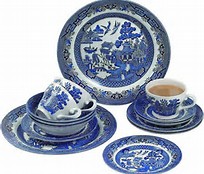
Blue WillowWillow is an elaborate design that has been used on kitchen ware for hundreds of years and probably got its start as Spode transferware. Various colors have been used, and mine is all of the popular blue variety. The lovely scenes that are depicted include detailed buildings, gardens, bridges, and figures, which found their inspiration in wares that originated in China. Various companies appear to use these patterns, and my wide assortment came from both grandmothers, my father’s oldest sister and my mother. They all remembered that I had expressed an interest in those dishes as a child, and that fact makes me treasure them even more. I sometimes use the small bowls or plates and regularly display my favorites. The patterns vary and several that really catch my eye are the ones made in Holland that include camels in their designs.

No matter which type of collecting, my favorite objects will always be those that invoke a memory of the past or the air of childhood. If you were to ask my grandchildren about what I collect, they would probably say “roosters,” and I admit that quite a few of them in various incarnations do reside in my kitchen. Although only a few of them are connected to childhood, like my mother’s egg cups, I’ve had most of them for years. If the roosters could talk, they would tell stories about the history of my former life and marriage, including observations on all of the interesting kitchen renovations where they have “lived.”

As far as the Trixie Belden books and Barbie dolls that I took away from my childhood home as a newly minted adult, I still have them. The pages are somewhat discolored and brittle. The words and pictures still carry a type of intrigue and predictable comfort that I hope to instill in my own writing for children. Barbie and Ken make a curious couple, with his right arm missing and her bouffant hair somewhat worn off from the back of her head. They’re still smiling, though, after all these years.Barbie and Ken



Memoir Publication and Garden Update

UP Reader

The U.P. Reader, which includes my memoir piece, “Lonely Road,” is now available in print and e-book! This literary magazine is published by Modern History Press in conjunction with the Upper Peninsula Publishers and Authors Association (UPPAA). The publication also contains fiction, humor, poetry, history, and more.

When I read the call for submissions, my first instinct was to write a fictional story set in Michigan’s U.P., where I lived for many years. What about my own, personal tales, just waiting to be told? I decided that memoir was the way to go.

As Barbra Streisand sang in one of my favorite movies, “The Way We Were,” memories really can “light the corners” of our minds. But, when too much pain is caused by remembering, we often choose to ignore and wall-off those sections of our brains. Writing memoir can be like taking the partitions down and letting the light shine, once again, onto those remembrances. The act can bring questions, heartache, revelations and healing.

Lonely Road” relates an evocative experience during my wintertime move to the Upper Peninsula, with the purpose of giving a faltering marriage one more try. The story is also a metaphor for the journey of life, with its pleasant surprises, difficult challenges, and safe havens. That “one more try” to stay together spanned several additional decades. Success or failure? Guess it depends on how you look at it. This was a very difficult piece for me to write because of all the emotions to which it gave rise. I would like to say that I felt better once I had it down. Saying it well and true did give me a sense of satisfaction. The sadness over our loss still remains.

I hope that you’ll consider reading about my experience, along with sampling contributions from other writers with connections to the Upper Peninsula, in the beautiful state of Michigan. The book is available from the publisher, through Amazon, and at several retailers in the U.P.  Reviews are welcomed!


GARDEN UPDATE

The Community Garden is looking quite bountiful these days! Cucumbers and zucchini are already producing. Today, I also spotted tiny green peppers and tomatoes. Giant sunflowers provide a lovely backdrop. My little plot contains huge marigolds and abundant basil. I’ve already taken several bags of the herb over to the food pantry. Basil is great in curries and salads. Pesto, anyone?

The rosemary is a bit on the small side, and I’m afraid the watering that’s helping the basil thrive may be somewhat of a negative for those plants, which often prefer drier conditions. They’re growing, though, and I snipped the ends to encourage even more growth. Did my molasses and orange oil concoction succeed in the fight against the fire ants? Yes and no. It worked well enough to drive them over to the other side of the little garden bed. At least they stay off the plants!