

When I scan the shelves in a bookshop, sometimes a volume chooses me! Irresistible qualities include eye-catching titles, outstanding cover art, smells that spark memories, or an author’s name that rings a bell.
For about two years, I had the pleasure of living in Marquette, Michigan, situated in the Upper Peninsula and perched on the shores of Lake Superior. A variety of bookstores graced that town, but my absolute favorite was Snowbound Books, within walking distance from my home and pictured above. At that time, the store’s vintage paperbacks huddled together in one section, and I always checked them, on the hunt for Dell Map Backs or other interesting finds.
During one of my frequent visits, a 1950 Pocket Book Mystery entitled Beyond a Reasonable Doubt chose me to be its owner. I had nothing to say about it. The book wasn’t a Map Back, but I had to have it, all the same. The title wasn’t what grabbed me; it was the author’s name…C.W. Grafton. Could they be related? One of my favorite mystery authors is Sue Grafton, author of the Kinsey Millhone Alphabet Mystery series, beginning with A is for Alibi. Hundreds of mystery authors could have the last name Grafton, I supposed.

In those hazy years before the Internet, facts and details weren’t available instantaneously at our fingertips like they are today. Months passed before I knew the answer to my question. Yes, they were related! C.W. Grafton was Sue Grafton’s father, who practiced as a lawyer and published three mystery novels. My new collection search had been born!
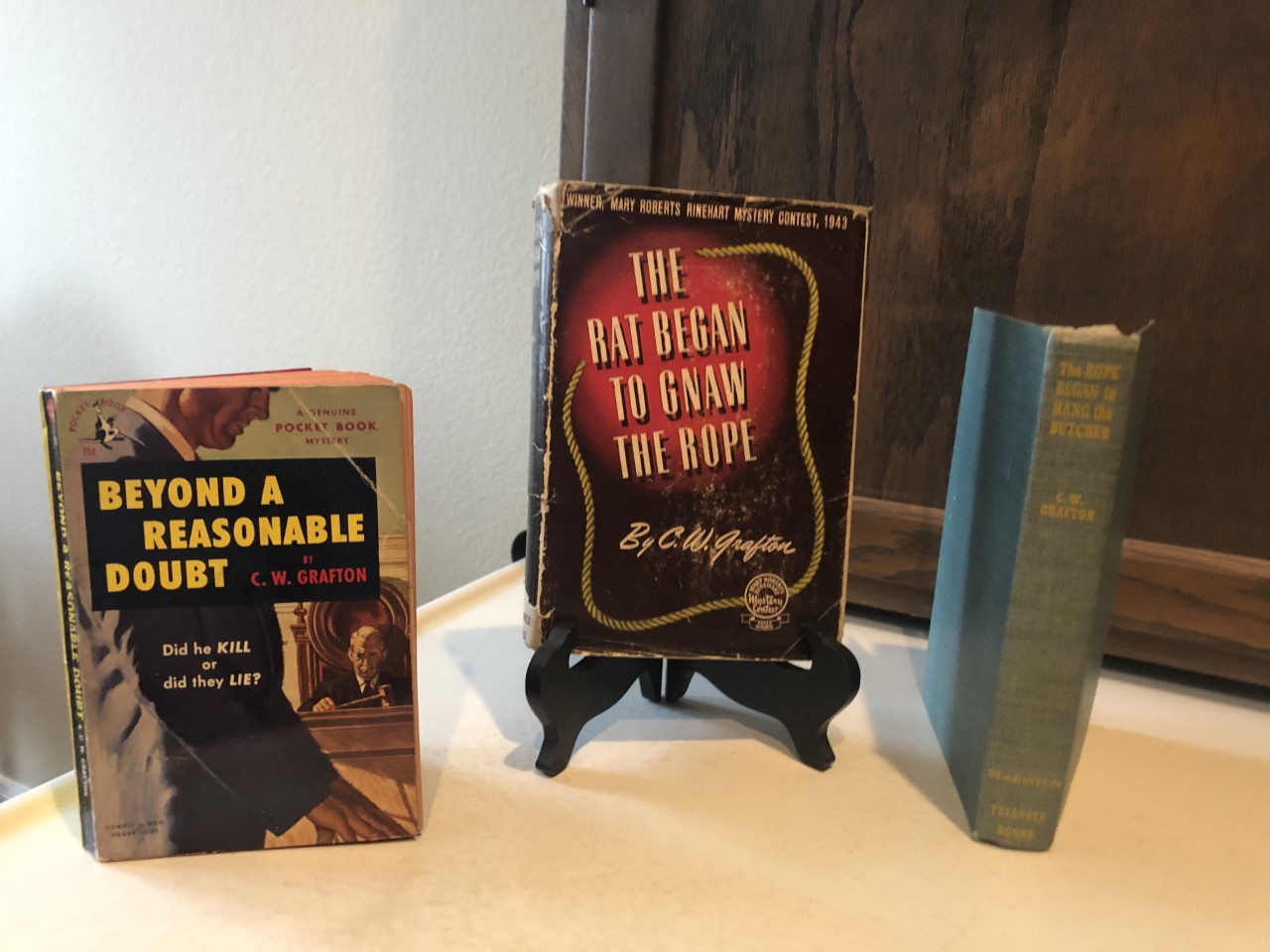
I don’t need much of an excuse to stop at a used bookstore or collectibles shop that might feature books. This new quest was one more reason to pull over when I saw a promising business sign. Decades went by, but I found all three! Which is my favorite? The paperback on the left is important, since it was the first. My purchase of The Rope Began to Hang the Butcher, on the right, was exciting because it was the last and completed this collection. The book shown in the middle, The Rat Began to Gnaw the Rope, is my favorite, for two reasons. First, this copy still proudly wears its jacket, however tattered. Second, the book is dedicated to C.W.’s youngest child, Sue, his other daughter, Ann, and wife, Viv. The family is shown below with the book in a 1944 photo, with Sue on the right.

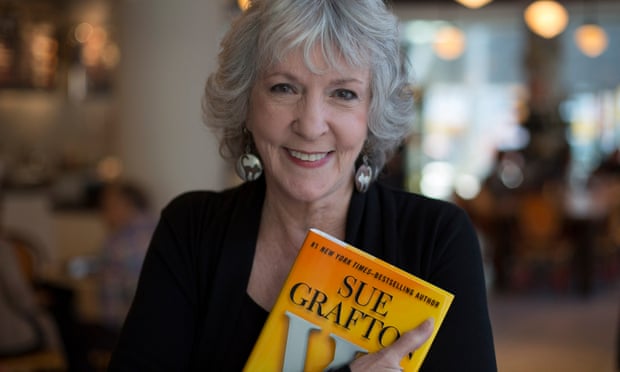
Over the years, I’ve read interviews in which Sue Grafton explains she was the survivor of a difficult childhood, due to both of her parents suffering from alcoholism. In her semi-autobiographical book, Kinsey and Me (2013), she credits her father with her own passion for the mystery genre, which served her well. Sue Grafton died in 2017, at age 77, just one book shy of the entire alphabet. I’ve read all her alphabet mysteries except the last one, Y is for Yesterday. Guess I don’t want them to end…
 What remains is a selection of childhood chapter books, Golden Books related to memories but collected as an adult, author-signed novels, and a few vintage tomes that are too wonderful (and smelly) to ever discard. The largest set in the lot is my Dell Mystery Map Backs. As a child, I loved books that included illustrations of maps. Imagine my delight as an adult to discover these wonderfully “campy” mysteries with the great front cover art (although sometimes a bit lurid) and maps on the backs to match the stories. When moving day arrived, the only map backs I had parted with were a few duplicates.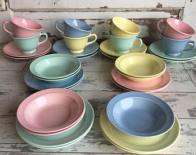
 Although Fiestaware, which is produced by the Homer Laughlin China Company, also of West Virginia, was introduced in 1936, my pieces are not in the realm of vintage, unless that includes a set purchased through the J.C. Penney catalog in the 1990s. I had admired these colorful, sturdy dishes at the homes of friends as a child, and when I had the chance to purchase dinnerware of my own they seemed like the logical choice. Fiestaware is available in a wide range of colors, and my set is composed of deep pastels, including turquoise. Over time, I’ve also added select pieces in red to be used as serving dishes. I often make use of the small plates and bowls while “cooking for one” and display the reds in my Hoosier-type cabinet in the fall and around the holidays.
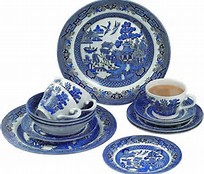 Willow is an elaborate design that has been used on kitchen ware for hundreds of years and probably got its start as Spode transferware. Various colors have been used, and mine is all of the popular blue variety. The lovely scenes that are depicted include detailed buildings, gardens, bridges, and figures, which found their inspiration in wares that originated in China. Various companies appear to use these patterns, and my wide assortment came from both grandmothers, my father’s oldest sister and my mother. They all remembered that I had expressed an interest in those dishes as a child, and that fact makes me treasure them even more. I sometimes use the small bowls or plates and regularly display my favorites. The patterns vary and several that really catch my eye are the ones made in Holland that include camels in their designs.
 Platform Number 4