As a typical kid growing up in the 1950s, I collected the usual sorts of things, like pretty stones, smooth driftwood, multi-colored marbles, favorite books and treasured dolls. I wasn’t really much of a “pack rat,” though, and by the time I moved away from home the only parts of those collections that remained were a set of Trixie Belden mysteries and a few Barbie dolls.
As the years went by, the basis for my taste in collectible books remained much the same: heavy on the mystery and brimming with nostalgia. Most of the books I’ve sought out or have purchased after being pleasantly surprised by their appearance hold a connection to the past. When my life hit a U-turn a few years ago, and I was faced with downsizing from a house to a small apartment, my treasured book collection took a necessary but serious hit.
 What remains is a selection of childhood chapter books, Golden Books related to memories but collected as an adult, author-signed novels, and a few vintage tomes that are too wonderful (and smelly) to ever discard. The largest set in the lot is my Dell Mystery Map Backs. As a child, I loved books that included illustrations of maps. Imagine my delight as an adult to discover these wonderfully “campy” mysteries with the great front cover art (although sometimes a bit lurid) and maps on the backs to match the stories. When moving day arrived, the only map backs I had parted with were a few duplicates.
Luckily my apartment has ample kitchen cupboard space, since my other main collecting activity has turned toward dinnerware, including Luray Pastels, Fiestaware, and Blue Willow. I really can’t bear to part with most of the pieces, since they were handed down to me from my grandmothers, mother, and several aunts.
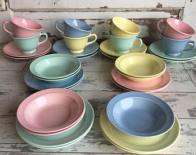
The delicate scrollwork and pastel tones of the pink, blue, yellow and green Luray originated in West Virginia, near the Luray Caverns, from 1938-1961 and were made by Taylor, Smith, and Taylor Company. The set I now have once belonged to my mother’s older sister, and they often make me think of our homes in Michigan. The only piece that I use daily is the yellow salt shaker, and my favorite example that’s on display is the blue teapot. For a period of time, light gray additions were also produced, but never caught on in popularity and were then dropped. Pieces in that color are now highly collectible, and I’m happy to say that I hung on to the gray Luray platter that I bought “for a song” some years back.
 Although Fiestaware, which is produced by the Homer Laughlin China Company, also of West Virginia, was introduced in 1936, my pieces are not in the realm of vintage, unless that includes a set purchased through the J.C. Penney catalog in the 1990s. I had admired these colorful, sturdy dishes at the homes of friends as a child, and when I had the chance to purchase dinnerware of my own they seemed like the logical choice. Fiestaware is available in a wide range of colors, and my set is composed of deep pastels, including turquoise. Over time, I’ve also added select pieces in red to be used as serving dishes. I often make use of the small plates and bowls while “cooking for one” and display the reds in my Hoosier-type cabinet in the fall and around the holidays.
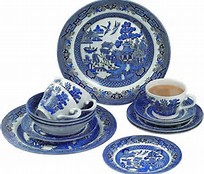 Willow is an elaborate design that has been used on kitchen ware for hundreds of years and probably got its start as Spode transferware. Various colors have been used, and mine is all of the popular blue variety. The lovely scenes that are depicted include detailed buildings, gardens, bridges, and figures, which found their inspiration in wares that originated in China. Various companies appear to use these patterns, and my wide assortment came from both grandmothers, my father’s oldest sister and my mother. They all remembered that I had expressed an interest in those dishes as a child, and that fact makes me treasure them even more. I sometimes use the small bowls or plates and regularly display my favorites. The patterns vary and several that really catch my eye are the ones made in Holland that include camels in their designs.
No matter which type of collecting, my favorite objects will always be those that invoke a memory of the past or the air of childhood. If you were to ask my grandchildren about what I collect, they would probably say “roosters,” and I admit that quite a few of them in various incarnations do reside in my kitchen. Although only a few of them are connected to childhood, like my mother’s egg cups, I’ve had most of them for years. If the roosters could talk, they would tell stories about the history of my former life and marriage, including observations on all of the interesting kitchen renovations where they have “lived.”
As far as the Trixie Belden books and Barbie dolls that I took away from my childhood home as a newly minted adult, I still have them. The pages are somewhat discolored and brittle. The words and pictures still carry a type of intrigue and predictable comfort that I hope to instill in my own writing for children. Barbie and Ken make a curious couple, with his right arm missing and her bouffant hair somewhat worn off from the back of her head. They’re still smiling, though, after all these years.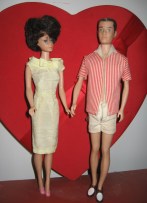




 Platform Number 4