In the past, I’ve had the privilege of rescuing several animals to adopt and save them from an uncertain future. I’ve also rescued plants heading for the compost pile, nurturing them back to health. But a type of mission I’ve accepted that is not as widely appreciated is the literary rescue!
You might ask, “What’s a literary rescue?” First, let’s look at what it is NOT.
As a teenager, I had my first sleepover with a friend I had known since elementary school. We had fun paddling a rowboat around the shallow inland lake across from her house. However, after dinner, we were told that my friend had to put in her hour of daily piano practice. What to do? I wouldn’t attempt the boat alone. And they lived on a country road, so I wouldn’t go walking around. I didn’t want to sit in the living room and stare at her parents (or have them stare at me). My only option seemed to be waiting in her sparsely appointed room. Then what? An hour with nothing to do can seem like an eternity to a teen.
Luckily, I discovered a small shelf filled with books in the corner of her room. These were old books, mostly without dust jackets, to provide clues about their contents. I grabbed one named Claudia because it was a girl’s name and started reading. The story was about a young, recently married woman who was not yet far beyond her teenage years. I was captivated. The sounds of piano music in the background faded away.
When my friend finally returned, I showed her what I’d been reading. She informed me that “all those old books” used to belong to her mother, and the girl didn’t like most of them. I’d started reading one and asked if I could borrow it and finish it later at home. She agreed and wrote her name inside. I thoroughly enjoyed the book. I hated to let it go. Months turned to years. About a decade later, I discovered Claudia was the first book of a charming series by Rose Franken. I’ve now read them all. I meant to return that book to my friend and maybe tell her how much I liked it. However, I never did, and I have now lost track of her. Sorry, Marilyn!
Did I actually “rescue” that book? Probably not. Because I kept it intentionally, some might say it was a “booknapping” rather than a rescue. And I doubt anyone in the family would have burned or thrown those vintage books into the trash anytime soon. But it certainly was a lucky, long-term borrow on my part!
A few years later, the summer I graduated from high school, I donned my bathing suit and walked to the local beach one afternoon. This wasn’t the park where all the teens hung out but a small, quiet affair where parents were more apt to take their little ones. I just wanted to get some sun and fresh air while enjoying the book A Summer Place by Sloan Wilson.
Engrossed in the story, I tuned out the few beachgoers around me and didn’t realize at first that the sun was no longer reemerging from behind the clouds. I finally noticed the chill and the appearance of goosebumps on my bare arms and legs. Deciding I should head home in case rain moved in, I put my book aside in the sand, threw my pop can (yes, we called it pop in Michigan) in the trash, and folded my blanket, stuffing it into my beach bag. I quickly set out for home.
A few blocks in, I realized I’d forgotten to pick up my book! The sky still looked ominous, but I retraced my steps. As I drew closer to the beach, I saw my book was nowhere near where I had left it. But I circled the narrow strip of sand, thinking maybe I had been wrong about the location. And then, I spotted it. A young mother tightly gripped my copy of A Summer Place as she rounded up her raucous bunch of kids to leave. Being the introvert I was (and mostly still am), I didn’t say a word and turned back toward home, feeling disappointed. Okay, I knew how the story ended because I’d seen the movie starring Sandra Dee and Troy Donahue. But I would still check it out from the library sometime to finish reading it.
Had that person “rescued” my book? She might have thought so (hello, woman from the beach; I hope you enjoyed it!). But I went back for my book to protect it from the elements, so I say it doesn’t qualify as an actual rescue on her part.
Years later, when I was teaching fourth grade in Michigan’s Upper Peninsula, an elementary school in a nearby county closed down. Their entire library of books was up for grabs. Many of them were brought to our school for teachers to select for their classrooms. Of course, many were old copies of familiar chapter books, such as those by Beverly Cleary. But they certainly added to this new teacher’s classroom library. My heartbeat raced when I saw two picture books by Swedish author and illustrator Maj Lindman. Her bright “Flicka, Ricka, Dicka” and “Snipp, Snapp, Snurr” series about two sets of triplets were my favorites as a child and the first ones I looked for at the library. Although the characters might have looked a bit younger than fourth grade, I would enjoy showing my students examples of books I had loved as a child. I grabbed one from each series.
When I moved away and left my job at that school, I dreaded leaving those books behind. I imagined the new fourth-grade teacher dumping anything outdated or what they considered overly young. I took the two picture books with me to share with my next group of students. Stealing? Not really, although I could have asked permission. I still have them with the old library cards tucked inside. A literary rescue? I like to think so!
Even after moving away, I often returned to Michigan’s Upper Peninsula. Hunting for used bookstores was a favorite summertime hobby. One year, I saw a sign that said, “Books in the Barn,” pointing down a dirt lane. Sure enough, there was an old barn full of used books! And this was not a barn fixed up to serve as a store. It was still just an old barn, open to the elements, daylight showing between the boards. The books all smelled somewhat musty. A friendly clerk said they had somehow ended up with the inventory but didn’t have an appropriate shop space. They would sell what they could that summer and get rid of the rest. The words “get rid of” rang in my ears. I bought several books that day. The ones that stuck in my mind were Jack Finney’s time travel duo Time and Again and From Time to Time. They were both warped from the humidity. But I enjoyed them immensely and didn’t give them up until years later during another move. Was this a literary rescue? Yes, I believe those purchases do qualify.
So, we could say the following conditions constitute a literary rescue: saving books that are in danger of being burned, drowned, thrown away, or otherwise ruined by the elements.
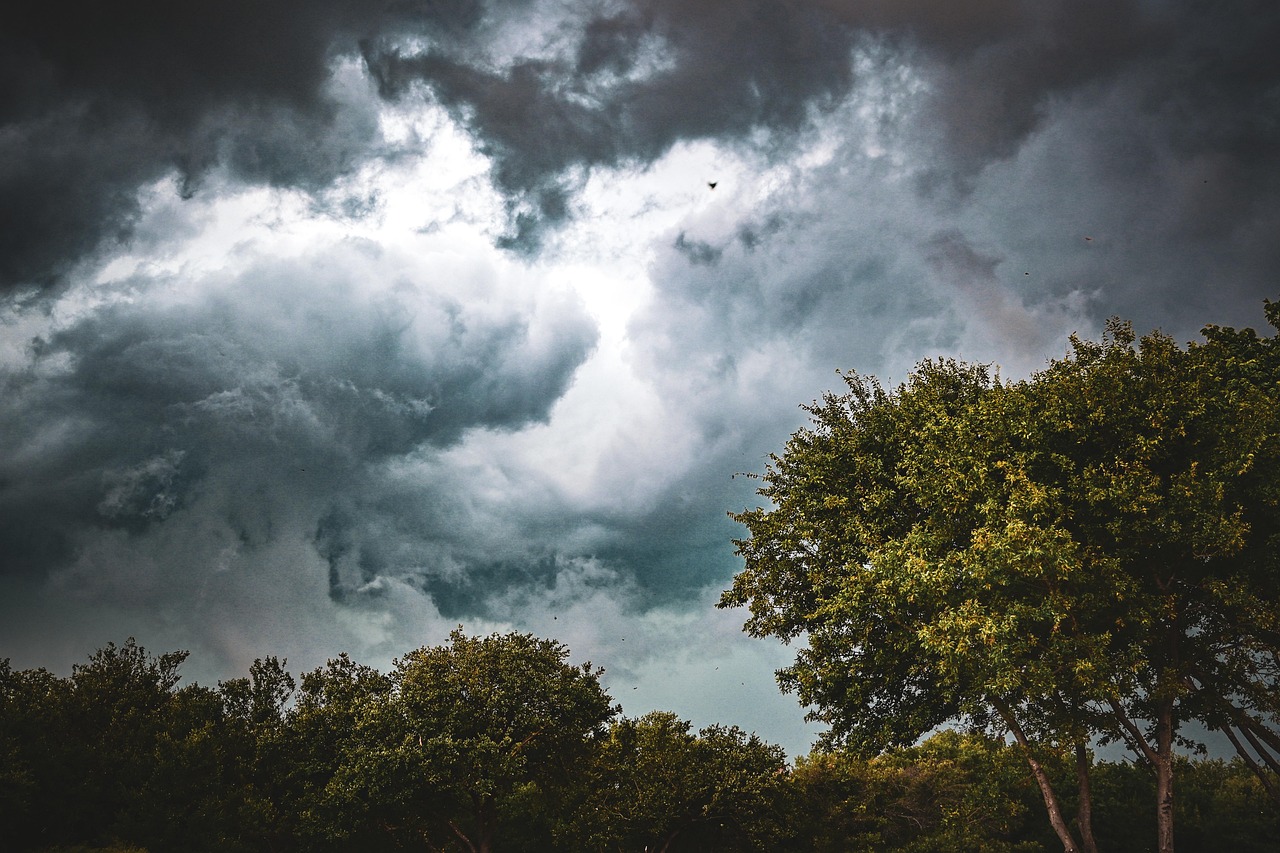
This brings me to a recent rescue event. Last autumn, I visited the library in the late afternoon. The air was warm, the breeze light, and the clear sky a bright blue. They keep the building very cold inside, so I wore a thin fleece. I had to return a few books, and the distance is just the right length for my daily walks. I began browsing the shelves with the new titles and eventually glanced up and outside. What? Leaves and branches flew past the windows, and the sky was unusually dark for that time of the day. I looked at my phone and saw the temperature had already dropped about 25 degrees. I checked out the book I’d found and headed for the door.
Outside, the cold wind hit me with force, and I was glad I’d worn the fleece, which at least offered minimal protection. A Blue Norther, I thought. One side of the sky had turned a much darker blue, and a solid curtain of steely gray clouds was moving in from the Northwest. This would not be one of those dry Blue Northers; rain was coming. I had forgotten to bring a bag with me. If rain started to fall, I’d have to put the book under my jacket. I quickly strode toward home.
My next mistake was the route I took. Yes, it was the most logical way to go. But I had to pass the corner where a Little Free Library was perched on my way. I often check that wooden stand for books on my walks and have made great finds. But the door was broken, yet again. Repeated repairs had failed. It kept breaking or falling off. That day, I didn’t want to look and tried to stay on the other side of the street. But it seemed as if someone had just added a collection of books. I didn’t need anything else to carry since I was only halfway home, and rain was imminent. But…I couldn’t help myself. I hurriedly rifled through the books. Don’t need, no, don’t need, no. Then, I saw it. A lovely vintage book of poetry by Henry Wadsworth Longfellow. Dark blue with gold and red trim. The pages were edged in gold. I opened it and sniffed. Ahh. I love the smell of old books. It was not in good shape and starting to fall apart. But could I leave it there to be ruined in the deluge? No.
I reached my apartment building just as the rain began to fall. Whew. It was then time to explore my literary rescue!
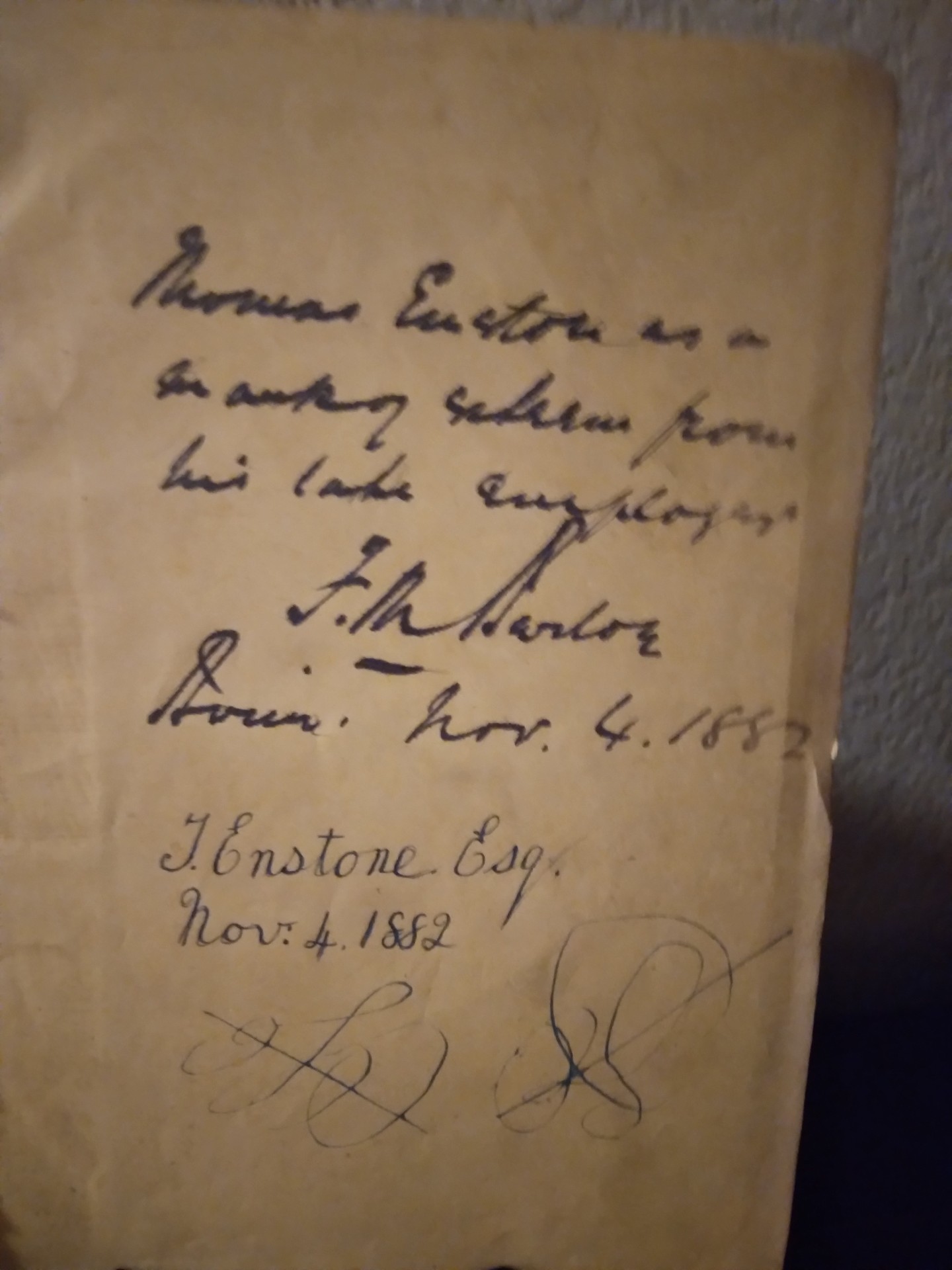
The book’s copyright date is 1882, inscribed by what looks to be F.M. Harlow to a late employee or employer, Thomas Enstone, that same year. The handwriting is difficult to read. Some poems are illustrated, such as “The Village Blacksmith.” Of course, the book sleuth in me was curious to know why a person might give this book to someone with whom they’d worked. What kind of business?
I’ve done some internet research at several points, trying to find out more about these individuals or a possible connection between them and the author. I found that Longfellow’s nephew worked with an architect named Alfred Harlow. In addition, there was a Louis Harlow, who illustrated some of Longfellow’s books. So, maybe the Harlows were related? That’s all I’ve come up with so far, but it’s fun to look! If you have any ideas, I’m interested!
Since that day, the door to the Little Free Library has come apart and been fixed several more times. But people continued to put books in there. I brought home several, although those were more contemporary. My apartment’s bookshelf space is limited, so I’ll either need to donate more of my books to the library’s little bookshop or give up literary rescues altogether!



Interesting journey of saving books. I thoroughly enjoyed this.
LikeLiked by 2 people
Thanks, Pat! I’m so pleased that you liked my journey:)
LikeLiked by 2 people
What great stories about your literary rescues and those who are more like literary escapades! I feel the same way about books. Hence my three full bookcases! My plan is to weed them this summer and donate some to SCARCEly Used Books in Chicago’s western suburbs.. Their goal is to keep books out of landfills, which is exactly what you have done!
LikeLiked by 1 person
So happy you enjoyed this! Yes, It’s very difficult to get rid of books, especially when we’re “rescuing” others and adding to our collections at the same time! That’s a great idea to donate them.
LikeLike
I love this. I have rescued a few books and had the great honor of a former student seeing a book at a yard sale and rescuing it for me. It’s one of my greatest treasures. And…I love Longfellow. The book she rescued for me is a compilation of European poetry edited by Longfellow.
LikeLiked by 1 person
So, our “rescues” are linked! I find this to be so interesting, and I can certainly believe you have rescued many books in your time, Martha:)
LikeLiked by 1 person
Yep. I love all my rescued books
LikeLiked by 1 person
They are the best!
LikeLiked by 1 person
Such a lovely post, Becky. Reading it made me feel like I was right there with you, getting lost in a story as a storm approached, breathing in the scent of an old book, the inability to pass up free books, … Thank you for not only the literary rescues but also for taking us along on those missions.
LikeLiked by 1 person
Wow, I’m so pleased you felt all that through my writing, Tracy! I appreciate you saying so:)
LikeLiked by 1 person
The Little Free Library is a brilliant concept. The beauty of books is not only do they have stories inside them, but they often change hands over the years and have stories to tell about their ownership. After I retired from teaching, I gave away many of my books to other teachers, but I also hung on to some to pass on to students who later became teachers when they were setting up their own classroom libraries.
LikeLiked by 1 person
You’re right, Pete, that Little Free Libraries are great! And sharing books with future teachers is a wonderful idea.
LikeLiked by 1 person
And here I thought you were primed and ready to rescue the big box of inhereted books under the bed in the guestroom!
LikeLiked by 1 person
Ha, ha! Thanks Liz:)
LikeLiked by 1 person
You’re welcome, Becky.
LikeLiked by 1 person
I approve. Keep up the good work! (I don’t think your friend would think ill of you).
LikeLiked by 1 person
Thanks, Alanna! Wish I could find her to tell her…
LikeLike
I love the idea of book rescues, Becky, and can relate to some of yours. I remember salvaging a couple of books from a paper recycle bin. One was about the Great Depression and the other an anthology of ghost stories with the spine ripped off. They’re both still somewhere in the house.
Little free libraries are sort of like halfway houses for wayward books. There are a lot of them where I live. I even know of a few in suburban back alleys!
LikeLiked by 1 person
I see your original message came through, Audrey. I liked reading about the details of your book rescues!
LikeLiked by 1 person
I love the idea of book rescues, Becky, and can relate to yours. That Longfellow book is beautiful. I once rescued a couple of books from a dumpster-like recycle bin, but they weren’t as special as that one.
Little free libraries are like shelters for wayward books. There are quite a few of them in my suburb, even a couple in back alleys!
LikeLiked by 2 people
Yes, Audrey, these “shelters” are a great way to share books! Thanks for reading AND rescuing!
LikeLiked by 1 person
I would like to apologize for these duplicated comments, Becky. WordPress kept telling me the comment could not be posted, but there was a Retry button. I clicked it several times with the same result before I gave up, not realizing the comments were actually going through. Blushing. 😯
LikeLiked by 1 person
No problem, Audrey! That happens to all of us, sometimes, as the posts may not show up right away. I often delete the repeated ones, but as I said, I liked the additional info in your other version. Thanks for not giving up!
LikeLiked by 1 person
Dear Book Rescuer … good job! All these little “finds” enrich our reading experience.
Whatever you do, Becky, should you go to NYC, do NOT go to the Strand Bookstore – https://www.strandbooks.com/ We will never see you again!
LikeLiked by 1 person
I’ve heard about that shop but have never been, Jeanne. It sounds and looks awesome!
LikeLiked by 1 person
It’s huge, and looks like it’s been overhauled and modernized, AND they have 4 branches now! It used to be the stereotypical dusty, musty old bookshop (though still huge), when I lived in the city, with tiny, narrow aisles and where any minute, a book could fall off a shelf. That was it’s charm. It looks rather organized from the link, but I’m sure it’s still fantastic.
LikeLiked by 1 person
I imagine it is! But you were lucky to visit it back in the day, as well:)
LikeLiked by 1 person
Becky, I loved your post so much. I understand your deep love for books and don’t worry about you shelf being full, start piling books on the floor like I do. This was such a wonderful story. I straighten the little free library on the corner everytime I walk by it. Sometime I find a treasure, other times it’s just house cleaning. I’m so happy you found the books you did and I hope the woman who found your book enjoyed it. I saw the movie too, by the way. LOL This was delightful. Thank you.
LikeLiked by 1 person
Ha! I do have double-deep piles on a bench in my bedroom:) Happy you like this and can relate, Gigi!
LikeLiked by 1 person
Your wonderful post reminded me of two things. The first was the habit my parents and I had of going to farm sales in the 1950s and early 1960s. Mom was after dishes, Dad looked for stamps, and I browsed the books. Books often were for sale for as little as $2/box, and the piles we brought home were substantial. Many were moved along in one way or another, but there were older volumes I just loved — for their smell and the bindings as much as anything.
The other thing you reminded me of was my own story of tracking down a man who was mentioned in an inscription in a used book I bought. I wrote about that more than a decade ago, but I’m inspired now to freshen up the story and post it again.
LikeLiked by 1 person
The smell of old books is great, isn’t it?! I look forward to reading your post about tracking down someone from an inscription!
LikeLiked by 1 person
fascinating; this drew me right in; yes, there ARE Little Free Libraries in our ‘hood but their doors are permanently hanging by the hinges; you’ve inspired me; I’ll don some clothes and go fora morning stroll and have a gander 🙂
LikeLiked by 1 person
I hope you find something good, John!
LikeLiked by 1 person
I did. Down the road, around a sunny corner and there it was. I took a few photos, Door hanging on its hinges. Full of books, I’ll put up a post sometime soon 🙂
LikeLiked by 1 person
Great!
LikeLiked by 1 person
Becky, this is such a wonderful story. I was glued. There’s nothing better than being the rescuer of books. You have ‘been there and done that’. Longfellow’s book is such a gift. My shelves at home are full. The old books with leather bindings are in the old corner cupboard with the glass front. My non-picture books are on the shelf under the big coffee table. Our gazillion other books are shelved downstairs. My picture books are at school. I have a hard time giving away books.
LikeLiked by 1 person
I’m so pleased that you enjoyed my story, Jennie! Yes, from one book-lover to another, I certainly know how difficult it is to part with beloved books!
LikeLiked by 1 person
Hear, hear! 😍
LikeLiked by 1 person
I really enjoyed this essay. It reminded me that I told myself to finish a book of my grandmother’s that I rescued decades ago and started, but did not finish. Thank you for this!
LikeLiked by 1 person
Hi Ramona! I’m happy that you liked this and found it to be beneficial:)
LikeLike
A marvelous post! I have a complicated relationship with books. I should write about it sometime. I was curious about the Rose Franken books, and looked to see if there was anything on YouTube of hers. I found that the Claudia stories were made into a radio show that I can listen to there.
LikeLiked by 1 person
Thank you! I had a tape at one time from the radio show. I prefer the books, as the radio show seemed rather light. In addition to still finding them in used bookstores and on eBay, you might be able to get them through interlibrary loans.
LikeLiked by 1 person
Well sure, the books are always better ^_^. I love interlibrary loans! SO generous. I get to read everything I can think of.
LikeLiked by 1 person
I love those loans, too. You can get your hands on almost any book you want!
LikeLike
Your passion for rescuing books shines through every story, making each “rescue” feel like a small act of preservation for literary history. I especially loved hearing about the Longfellow book and how even old, forgotten treasures can find new life with someone who truly values them.
LikeLiked by 1 person
Happy you enjoyed it!
LikeLike
Interesting story! Thanks for sharing it with all of us!
LikeLiked by 1 person
And thanks so much for reading, Lisa!
LikeLiked by 1 person
It’s fun to read about how you rescued books.
LikeLiked by 1 person
Thanks, Sheryl. Happy you enjoyed it!
LikeLike
I found this a fascinating read, Becky. I’m intrigued by the concept of ‘literary rescue’ 🙂
LikeLiked by 2 people
Thanks, John! I’m glad you enjoyed.
LikeLiked by 1 person