I’m very thankful for the two local critique groups that I attend and always leave feeling renewed and inspired. One is a well-established combination of writers from all different genres. I lead the second one, which is a newer compilation of writers and illustrators for children’s literature. Each group meets in person monthly, and occasional digital critique swaps are also requested and take place in between our gatherings. Since I’ve been taking part and observing for some time, now, several aspects for effectiveness have jumped out at me and motivated the following suggestions:
*When commenting in writing or orally, try to start out with a positive, follow with suggestions, and possibly end with another positive, as time allows (“sandwich” approach)
*Point out specific sections of the pieces for examples whenever possible, instead of speaking in generalities
*Keep in mind “nerves” and any misgivingsyou may have had when you first joined the group, upon greeting new attendees
*When receiving feedback, try to listen to a member’s full comments before responding with an explanation of your thinking or reasoning (this can be difficult to do!)
*Share your successes AND your disappointments, which can help to form connections between members
*Offer critiques on a continuing basis, even during those times when your own work is not being shared
Am I ALWAYS successful in remembering to do each of these things? I admit that I’m not, but these are my goals, since I can see how these strategies work so well when implemented. Feel free to add comments with ideas you’ve found to be especially helpful in your own groups!
In the Midwest, the invigorating change of the seasons was often marked by melting or returning snows, reappearance or disappearance of greenery and flowers, along with changes in the patterns of wildlife visiting the yard. In Texas, transformations related to precipitation, flora and fauna are much more subtle to the non-scientific eye. For me, the main difference is whether or not I can comfortably open my windows. With a twenty degree drop in the temperature since yesterday, today is one of those marvelous days to open the windows wide.
This may sound like such a simple and even mundane act, but it’s an activity that many Texans, who are accustomed to such high temperatures, often seem to overlook. Indeed, many of the local apartment buildings, including my own, do not include window screens. That presents a choice to be made: leave the windows closed at all times, open them and risk unwanted flying visitors, or add some sort of protection. During my first autumn here, I remembered a type of free-standing window screen from childhood that opened like an accordion to fit various sized apertures. Where was my handy neighborhood hardware store when I needed it? Impatience had a hold on me, and ordering through the internet would have taken too long. Surprisingly, I found several at Wal-Mart, after sifting through a pile where many seemed to be damaged. I was on my way to opening my windows.
The next issue was how to make sure the new screens didn’t fall out onto those passing below, since their fit into the window opening isn’t exactly fool-proof. I found articles posted by individuals on the internet about just this topic, with suggestions that involved carpentry (not for me), Velcro, and removable adhesive putty. I went with a white version of the latter, since I was familiar with its easy and mess-free use from mounting things on my classroom walls as a former teacher. Just one little wad on each wooden end piece, while leaving my window closed a little farther than the height of the screens, and I secured them in place. Depending on the configuration of your windows, this may not be an air-tight fit, and you might still need to be on the lookout for small insects. I would certainly avoid these types of screens if I had a curious pet or young child.
Today’s cool breezes feel glorious. I can hear light traffic noises, occasional bird calls and distant voices. When opening the windows, we also put ourselves out there and share somewhat personal snippets of our lives, such as escaping cooking smells, voices, and the sounds of our favorite music, television program or current audio book.
The act of writing is a bit like opening windows. In sharing memoir and personal essays, we reveal our beliefs, feelings and memories to the world. Even in fiction, we raise the sashes that protect our personal experiences on which plots and characters are often based. We take a chance on rejection, disregard, or disagreement when opening ourselves up to the public, whether we share through a critique group, blog, website, self-publication, or if we publish in a traditional format. The potential rewards are many. Other writers and the public at large often embrace our written ideas and may offer helpful feedback, as well.
As writers, we should try to avoid being fearful of the results, take chances, and open our windows to the world beyond.
As a typical kid growing up in the 1950s, I collected the usual sorts of things, like pretty stones, smooth driftwood, multi-colored marbles, favorite books and treasured dolls. I wasn’t really much of a “pack rat,” though, and by the time I moved away from home the only parts of those collections that remained were a set of Trixie Belden mysteries and a few Barbie dolls.
As the years went by, the basis for my taste in collectible books remained much the same: heavy on the mystery and brimming with nostalgia. Most of the books I’ve sought out or have purchased after being pleasantly surprised by their appearance hold a connection to the past. When my life hit a U-turn a few years ago, and I was faced with downsizing from a house to a small apartment, my treasured book collection took a necessary but serious hit.
What remains is a selection of childhood chapter books, Golden Books related to memories but collected as an adult, author-signed novels, and a few vintage tomes that are too wonderful (and smelly) to ever discard. The largest set in the lot is my Dell Mystery Map Backs. As a child, I loved books that included illustrations of maps. Imagine my delight as an adult to discover these wonderfully “campy” mysteries with the great front cover art (although sometimes a bit lurid) and maps on the backs to match the stories. When moving day arrived, the only map backs I had parted with were a few duplicates.
Luckily my apartment has ample kitchen cupboard space, since my other main collecting activity has turned toward dinnerware, including Luray Pastels, Fiestaware, and Blue Willow. I really can’t bear to part with most of the pieces, since they were handed down to me from my grandmothers, mother, and several aunts.
The delicate scrollwork and pastel tones of the pink, blue, yellow and green Luray originated in West Virginia, near the Luray Caverns, from 1938-1961 and were made by Taylor, Smith, and Taylor Company. The set I now have once belonged to my mother’s older sister, and they often make me think of our homes in Michigan. The only piece that I use daily is the yellow salt shaker, and my favorite example that’s on display is the blue teapot. For a period of time, light gray additions were also produced, but never caught on in popularity and were then dropped. Pieces in that color are now highly collectible, and I’m happy to say that I hung on to the gray Luray platter that I bought “for a song” some years back.
Although Fiestaware, which is produced by the Homer Laughlin China Company, also of West Virginia, was introduced in 1936, my pieces are not in the realm of vintage, unless that includes a set purchased through the J.C. Penney catalog in the 1990s. I had admired these colorful, sturdy dishes at the homes of friends as a child, and when I had the chance to purchase dinnerware of my own they seemed like the logical choice. Fiestaware is available in a wide range of colors, and my set is composed of deep pastels, including turquoise. Over time, I’ve also added select pieces in red to be used as serving dishes. I often make use of the small plates and bowls while “cooking for one” and display the reds in my Hoosier-type cabinet in the fall and around the holidays.
Willow is an elaborate design that has been used on kitchen ware for hundreds of years and probably got its start as Spode transferware. Various colors have been used, and mine is all of the popular blue variety. The lovely scenes that are depicted include detailed buildings, gardens, bridges, and figures, which found their inspiration in wares that originated in China. Various companies appear to use these patterns, and my wide assortment came from both grandmothers, my father’s oldest sister and my mother. They all remembered that I had expressed an interest in those dishes as a child, and that fact makes me treasure them even more. I sometimes use the small bowls or plates and regularly display my favorites. The patterns vary and several that really catch my eye are the ones made in Holland that include camels in their designs.
No matter which type of collecting, my favorite objects will always be those that invoke a memory of the past or the air of childhood. If you were to ask my grandchildren about what I collect, they would probably say “roosters,” and I admit that quite a few of them in various incarnations do reside in my kitchen. Although only a few of them are connected to childhood, like my mother’s egg cups, I’ve had most of them for years. If the roosters could talk, they would tell stories about the history of my former life and marriage, including observations on all of the interesting kitchen renovations where they have “lived.”
As far as the Trixie Belden books and Barbie dolls that I took away from my childhood home as a newly minted adult, I still have them. The pages are somewhat discolored and brittle. The words and pictures still carry a type of intrigue and predictable comfort that I hope to instill in my own writing for children. Barbie and Ken make a curious couple, with his right arm missing and her bouffant hair somewhat worn off from the back of her head. They’re still smiling, though, after all these years.
I didn’t really consider going to church, today, but did feel an essence of spirituality while I spent some time at the community garden. I was all “alone,” surrounded by the noise of buzzing bees, chirping birds, and tall plants of okra brushing against each other in the breeze.
How can we be certain this lovely planet will be preserved?
All the sights, sounds and smells seemed magnified. Being in the outdoors has that effect on me, even more so, since I no longer own a personal piece of nature. My back had really started to tighten up by the time I finished some watering and weeding, though it has been feeling much better, most days.
Thankful I can still manage doing so many things.
A train rumbled past, just beyond the black, wrought-iron fence. I remember reading that when a tornado is headed towards you, it sounds just like a freight train. The thought gave me a cold chill, in spite of the hot sun beating down on me.
Grateful I haven’t seen any of those since moving to Texas.
What horror so many Texans must have recently suffered when Hurricane Harvey was upon them. And now to live with the destruction that’s been left behind.
Please don’t give them more than they can bear.
Back in the apartment, I worked at my computer for most of the day and ventured outdoors for a walk before dark. It was another beautiful evening, although warmer than this ‘northern girl’ prefers in September. Gentle wind all around, pink sun going down in the west, full moon rising in the east. People out strolling, alone or in couples, and some exercising their dogs on leashes. I felt the absence of mine. Person and dog.
Relieved I am learning to make peace with my loss.
As I drew near to the parking garage, I wondered if I would catch any of the ghostly saxophone sounds. No such luck, although I have heard the music on two separate occasions. Coming into the open, there was a full view of the setting sun on the horizon and a beautiful scene with the church silhouetted against the orb’s bright light. My heart felt full.
Please keep my loved ones safe.
Just as I finished that thought, the outdoor electric sconces of the church flickered on to begin their nightly vigil. Completing my route past the church, around the library, and skirting the burbling fountain, I experienced a dawning realization.
In case you are not familiar with miso, this is a fermented paste, traditionally made from soybeans and various grains, which is used as a seasoning in many Japanese dishes. More recently, miso also may contain chickpeas, quinoa, or other ingredients as the base. The color and taste of your miso will depend on the type you choose. Resulting flavors range from salty to sweet and savory to fruity, all the while retaining a wonderful, earthy taste. It is said to contain protein and vitamins, and versions with reduced salt content may be found in select markets.
Miso first came to my attention years ago when it was called for in a recipe from a Japanese cookbook. I had forgotten about it until last week, when coming across an instant version of tofu miso soup at the grocery store. It wasn’t too bad and reminded me how much I like miso. In that format, however, the servings were very small, fairly expensive, and the dehydrated tofu squares were miniscule. Why not make the real thing?
After searching in several stores, I found a tub of miso in the refrigerated produce section. It was a light-colored version and had a somewhat sweet, but earthy flavor. I started my cooking experiment with several cups of water in a pan and began to spoon miso, while heating and stirring until it was dissolved and had the taste I wanted. I then added quartered mushrooms, along with slices of the white part of a green onion and continued to simmer.
Meanwhile, I cut a quarter tub of tofu and arranged the cubes in the bottom of a soup bowl. When the vegetables in the soup were soft, I poured it over the tofu and added soy sauce, to taste, with a few snips of the onion greens for color.
M-m-m-marvelous!
Other Possibilities
Leave out the mushrooms, onion, tofu and/or soy sauce.
Add any of the following:
Chopped bok choy or spinach
Dried sea vegetables
Bonito (fish) flakes
Dried/ground shrimp
Anchovy paste
Fish or other seafood
Sesame oil
My Own “Instant” Version
*Heat water in a pan.
*Place small cubes of tofu in the bottom of a large mug.
*Slice mushrooms (or use canned) on top of the tofu.
*Add a spoonful of miso, along with any other desired flavorings.
*Pour boiling water over the contents in the cup.
*Stir, until the miso is dissolved.
*Cover the cup for several minutes to blend flavors.
How have you cooked with miso? I’d love to read about your ideas in comments!
On steamy days like these, when the temperatures reach the high 90s, I wait until just before dark for my walk. The humidity hovers, and I have to push myself to reach my usual brisk pace. Water bottle held in one hand and phone in the other.
I pass familiar buildings, inhale the aromas from nearby restaurants, and check on the abundant brown rabbits that scamper in and out of bushes near homes and businesses. Happy to reach the halfway mark, I then turn.
Last evening, that change in direction delivered a clear view of the pinkish-orange platter of sun beginning its dip below the edge of the world. Even warmer on that leg of the walk, I then stopped for a swig of water.
Heading past a construction zone shut down for the day, I crossed the pavement and was met by a delicious breeze funneling along the street. The air was much cooler, and the rest of my walk would be easier.
When I stepped onto the sidewalk at the other side, I heard it. Saxophone music. It didn’t seem electronic, but more like a real person playing an actual saxophone. The notes, sounding like practice or scales, emanated from a four-story parking garage set in the block between a large church and library. I stopped, mesmerized.
Who could it be and why? Unusual acoustics. My senses strained on overload, while I looked and listened. Pastel fingers of sunset reaching from the horizon pointed at a slice of moon visible in the sky, above. The scents of miniature roses and squat rosemary bushes tickled my nose.
As I stood, imagining the musician, the casual noodling evolved into clear, plaintive melodies. One of those movies where lovers share dinner on a rooftop garden amid asphalt and skyscrapers came to mind. That song. I knew that song. Humming along, the words took shape in my head. “Fly me to the moon…hold my hand.”
Romantic, memorable and haunting. I try to forget, but thought about you, while I continued the journey back home.
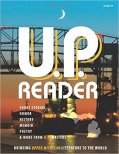
The U.P. Reader, which includes my memoir piece, “Lonely Road,” is now available in print and e-book! This literary magazine is published by Modern History Press in conjunction with the Upper Peninsula Publishers and Authors Association (UPPAA). The publication also contains fiction, humor, poetry, history, and more.
When I read the call for submissions, my first instinct was to write a fictional story set in Michigan’s U.P., where I lived for many years. What about my own, personal tales, just waiting to be told? I decided that memoir was the way to go.
As Barbra Streisand sang in one of my favorite movies, “The Way We Were,” memories really can “light the corners” of our minds. But, when too much pain is caused by remembering, we often choose to ignore and wall-off those sections of our brains. Writing memoir can be like taking the partitions down and letting the light shine, once again, onto those remembrances. The act can bring questions, heartache, revelations and healing.
“Lonely Road” relates an evocative experience during my wintertime move to the Upper Peninsula, with the purpose of giving a faltering marriage one more try. The story is also a metaphor for the journey of life, with its pleasant surprises, difficult challenges, and safe havens. That “one more try” to stay together spanned several additional decades. Success or failure? Guess it depends on how you look at it. This was a very difficult piece for me to write because of all the emotions to which it gave rise. I would like to say that I felt better once I had it down. Saying it well and true did give me a sense of satisfaction. The sadness over our loss still remains.
I hope that you’ll consider reading about my experience, along with sampling contributions from other writers with connections to the Upper Peninsula, in the beautiful state of Michigan. The book is available from the publisher, through Amazon, and at several retailers in the U.P. Reviews are welcomed!
GARDEN UPDATE
The Community Garden is looking quite bountiful these days! Cucumbers and zucchini are already producing. Today, I also spotted tiny green peppers and tomatoes. Giant sunflowers provide a lovely backdrop. My little plot contains huge marigolds and abundant basil. I’ve already taken several bags of the herb over to the food pantry. Basil is great in curries and salads. Pesto, anyone?
The rosemary is a bit on the small side, and I’m afraid the watering that’s helping the basil thrive may be somewhat of a negative for those plants, which often prefer drier conditions. They’re growing, though, and I snipped the ends to encourage even more growth. Did my molasses and orange oil concoction succeed in the fight against the fire ants? Yes and no. It worked well enough to drive them over to the other side of the little garden bed. At least they stay off the plants!
Meandering garden paths formed the outline of my pleasant childhood. In dreams, I see the grape arbor that separated our manicured yard from the large garden and offered sustenance for the birds. As summers wore on, rows of vegetables and flowers blurred and overran with plenty. Standing out in memory are crisp cucumbers, tart rhubarb and stately iris. I realized later in life that I should have paid more attention to my parents’ gardening techniques. Very little had stuck with me, except a love of that entity called “garden.”
Lack of knowledge, funds and assistance thwarted my early attempts at gardening as an adult. I still loved the idea of growing things, however, and did manage to nurture some healthy annuals, daylilies and rhubarb.
As life unfolded, I had the opportunity to experience gardening in various climates. Azalea and camellia in the south. Daffodils, iris and clematis in the north. Most recently, I accepted the challenge to grow vegetables in northern Michigan, planting tomatoes, bell peppers, leaf lettuce and pole beans. My efforts met varied success. Critters liked the tomatoes, so very few made it to the kitchen. Lettuce was plentiful, and regrowth was almost instantaneous after harvest. The pole beans took a while getting started, but a wooden teepee-like form covered with the slim green darlings was my crowning achievement for several summers until I moved.
When sleep is difficult to find, these nights, I sometimes walk through that northern yard in my mind, smelling the lilacs, touching the rubbery hosta leaves, checking to see if tender plants need water. How is it possible that my life offers no personal outdoor space and only windows to sun my numerous houseplants? Yes, there is natural beauty and plenty all around, but none of it is “mine.”
Of late, a search led me to the nearby community garden where citizens plant and tend crops for donation to the local food pantry. Because I’ve never done much gardening in this hot and dry Texas climate, I decided to ease into it by adopting a small plot. A volunteer had planted my rectangle of earth with herbs, since the season was already in full swing. Enough space remained to add some marigolds, theoretically to inhibit rabbits from stopping by for dinner.
As it turns out, I also “adopted” a nest of fire ants, and I’ve been battling them with a safe mixture of citrus compost tea, orange oil, natural dish soap and molasses. Either I’m winning the fight, or they have burrowed farther into the earth. I certainly won’t dig any deeper to find them! (Please see additional ideas, below.)
Rabbits ignored the marigolds to feast on my rosemary and English thyme. The pungent basil remained intact, however. I purchased an organic mixture to spray around plant bases, which involved some type of animal urine and promised to ward off both rabbits and deer. Last time I watered, I saw some growth, so that may be a success. Larger plots at the community garden boast squash, pumpkins, cucumbers and tomatoes, just to name a few.
Not sure what the future holds. Will I ever again have my own yard? Should I adopt a larger plot next year to contribute in a more meaningful manner? Could I actually have both? Only time will tell…
Anti-Fire Ant: non-toxic ideas
Compost tea (citrus peels simmered in water)
Molasses
Orange oil (essential oil, not cleaning oil)
Liquid dish soap (natural/non-toxic)
(Use about a cup of the above in a gallon of water, to be poured down into the center of ant hill.)
Add citrus compost tea when watering at any time.
Pour plain boiling water into the center of hill when ants are “at rest.”
Leave citrus peels in/near ant hill and throughout garden.
I spent years trying to please others through the act of cooking. As a young newlywed, I collected recipes that I wanted to try out on my husband and promptly struck out. If it didn’t look like something that his mother or grandmother often made, then he wouldn’t even taste it. For example, only “fried chicken” was acceptable, he said, and my attempt at that dish was met with disdain. Come to find out, his mother’s secret for “fried chicken” was really “Shake-n-Bake”! I gave up before I even got started. Over the years, I found quick and inexpensive foods that my daughters would eat. End of story (and marriage).
My second husband was a self-taught gourmet cook. No, I’m not just saying this in case he still reads my blog. He really is that accomplished and taught me a lot about cooking methods and ingredients. We took turns cooking, and I have to admit, that as my skills grew, I began to feel a bit competitive. My dishes started to turn out wonderfully and earned well-deserved praise. When my efforts didn’t work out, there were no polite or pretend compliments from him, either.
Cooking never came naturally to me, however, and I almost always relied on cook books and carefully measured ingredients. If a recipe was successful, I made a note of it on the inside of the book for future reference. Sometimes the pressure of producing acceptable meals was a negative force. Things went downhill when I started having digestive problems and had to give up many of our favorite foods and most wine. I won’t pretend these restrictions caused the end of our marriage, but they certainly did alter the daily dynamic of an already strained relationship.
I currently find myself “cooking for one,” a phrase that I’ve never really liked. I don’t even much care for recipes that say, “Cooking for Two,” as if someone is missing and this is all you have left. I occasionally prepare a meal for others, but more often than not, there’s one plate on my faux-Victorian dining table.
I made the early decision NOT to fall into the trap of watching television while eating. Sometimes I listen to my music, or enjoy tunes that emanate from a local activity in the Square, like the one going on as I write this piece. Other times, I read from a novel or non-fiction of recent interest, such as Art of Memoir, by Mary Karr. Weak indirect lighting over my table was an issue for reading. To fix that problem, I recently splurged on an attractive, industrial-style table lamp with a high-powered bulb, in an old-fashioned tone of light green.
Another big change is WHAT I make for dinner. First of all, I’ve cut way back on meat and more often turn to other forms of protein…eggs, tofu, beans, and occasional seafood. Sometimes just a large salad appeals to me, and I jazz it up with some of my favorites, like olives, capers, and fresh veggies lightly cooked. My go-to cheeses are feta and goat, since they seem easier for me to digest. Olive oil ALWAYS for cooking and salads! I rarely buy according to a recipe, now, but purchase ingredients that look good to me and then just decide what to do with them, later.
I’m starting to have fun with this and don’t think I’ll go back to eating by candlelight any time soon. Following is one of my recent culinary creations:
Egg-cellent Baked Mushrooms
One or two extra-large portabella/portobello mushrooms, stems removed, cap side up in baking pan
One egg for each, cracked open into the mushroom cap
Your choice of fresh or dried herbs to taste
Light sprinkling of cheese, if desired
Bake at 350˚-400˚ until egg is set to your liking and mushroom is sufficiently tender (about 20 minutes minimum).
Baby Becky, with Parents and Big SisterChildhood HomeThe Three of UsCleaned Up Nicely
This is my “birthday week,” which is thought-provoking on so many different levels. More than anything, though, this occurrence evokes a multitude of childhood memories. I feel lucky to have grown up within a loving family in Tawas City, Michigan, with both sets of grandparents living nearby. Although it may not be a new concept, I thought it would be fun to tell you more with a different voice, through an interview with a younger version of myself:
What do you like about your hometown?
All the four seasons are really clear, here. We can have lots of fun outside during the winter, in the snow, like ice skating and building snow forts. In the summer, we go swimming at the beach, in Lake Huron. It’s a small town, but has most of what we need. People called tourists come to visit a lot, too, which makes things different all the time.
Tell me about your hobbies and what you like to do for fun.
I like to play with friends, ride my bike, play softball, roller skate, climb trees, collect rocks, play with dolls, and read.
What do you like to read?
At school, it’s mostly stories like “Dick and Jane,” but at home I read about “Trixie Belden” and “Nancy Drew.” They’re so brave! My favorite book so far, though, is “Mystery of the Golden Horn,” by Phyllis Whitney. My sister, Terri, is the one who got me interested in mysteries.
Who are the friends you enjoying spending time with?
Well, that changes a little over time, but my best friends, so far, have been Andrea, she’s my neighbor, and Marilyn and Jean, who go to school with me.
No boys. Are you only friends with girls?
Course not. I just didn’t want to mention them, so it wouldn’t sound like I was saying they’re my boyfriends!
What about school…what do you like best or least?
I like reading and spelling, I guess, ‘cause I’m good at them. I also like seeing my friends there and playing jump rope at recess. Arithmetic is my least favorite, since I’m not as good at that. I don’t like fire drills, either, because we have to go down the dark, scary back stairs to get out of the school.
Tell me about your family.
I have five people in my family, and I’m the middle one of three kids. My sister is five years older than me, and my brother, Mark, is five years younger. I guess you can see why my favorite number’s five! My dad travels for work a lot, so my mom does most things around the house. He still takes care of the big yard, though, and he’s really good at growing stuff.
Do you have any regrets, or things that you feel sorry about?
Well, I wish that I hadn’t gotten my pony tail cut off when I did, ‘cause now I’m stuck with short hair. My friend, Andrea, got hers cut, and I thought it looked like a good idea. I’m also sorry that my grandparents…my mom’s parents…just moved away to California. Course, I did get to go to Disneyland when we went to visit! One more thing. I’m sorry that I don’t practice the piano more, since my parents pay for me to take lessons. So, I’m not very good at it, but at least I learned how to read music.
What would you like to do when you’re a grown-up?
I want to be a good mother, like my mom is. I think I’d like to be a teacher, too, since I’ve had some teachers I really liked who made school fun. Also, my sister and I have started writing a book, and we’ll see how that goes. Maybe I could try being a writer someday!

 What remains is a selection of childhood chapter books, Golden Books related to memories but collected as an adult, author-signed novels, and a few vintage tomes that are too wonderful (and smelly) to ever discard. The largest set in the lot is my Dell Mystery Map Backs. As a child, I loved books that included illustrations of maps. Imagine my delight as an adult to discover these wonderfully “campy” mysteries with the great front cover art (although sometimes a bit lurid) and maps on the backs to match the stories. When moving day arrived, the only map backs I had parted with were a few duplicates.
 Although Fiestaware, which is produced by the Homer Laughlin China Company, also of West Virginia, was introduced in 1936, my pieces are not in the realm of vintage, unless that includes a set purchased through the J.C. Penney catalog in the 1990s. I had admired these colorful, sturdy dishes at the homes of friends as a child, and when I had the chance to purchase dinnerware of my own they seemed like the logical choice. Fiestaware is available in a wide range of colors, and my set is composed of deep pastels, including turquoise. Over time, I’ve also added select pieces in red to be used as serving dishes. I often make use of the small plates and bowls while “cooking for one” and display the reds in my Hoosier-type cabinet in the fall and around the holidays.
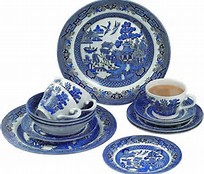 Willow is an elaborate design that has been used on kitchen ware for hundreds of years and probably got its start as Spode transferware. Various colors have been used, and mine is all of the popular blue variety. The lovely scenes that are depicted include detailed buildings, gardens, bridges, and figures, which found their inspiration in wares that originated in China. Various companies appear to use these patterns, and my wide assortment came from both grandmothers, my father’s oldest sister and my mother. They all remembered that I had expressed an interest in those dishes as a child, and that fact makes me treasure them even more. I sometimes use the small bowls or plates and regularly display my favorites. The patterns vary and several that really catch my eye are the ones made in Holland that include camels in their designs.