Ding Dong School: before Mister Rogers & Sesame Street

Miss Frances Ding Dong School
“Miss Frances”

The day after Labor Day was always the first day of school in Michigan. One of my earliest memories is of my older sister, Terri, heading out for school the year I must have been four. I can see myself sitting in the bay window of our living room, and she alerted me that she was leaving for school, but mentioned how “lucky” I was that I got to stay home and watch “Ding Dong School” on television.

It all seemed rather dubious to me, since I WAS looking forward to kindergarten the next year, but it was kind of her to make the attempt. My mother looked on and seemed to be trying to gauge my response. I suppose it was hard for me to face summer’s end and be the only child remaining at home, since my younger brother was not yet born.

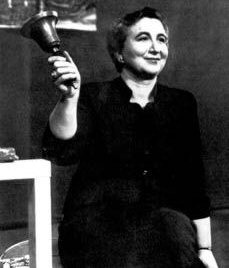
I DID love the show, however, and since we only had clear reception of one network in our little town in Northern, Lower Michigan, I was lucky that it ran on NBC through 1956 (followed by syndication for some years after). The presenter, Dr. Frances Horwich, known to the young viewers as our teacher, “Miss Frances,” had a calm, soothing voice that seemed to be aimed directly at me. The show always began with her ringing the large school bell, of course. She read books to us, presented various types of interesting lessons, and demonstrated art projects. Children often sent their drawings and other works in to the show, and Miss Frances would sometimes share those, as well.

a suitcase with a surprise

Sources reveal that she was an experienced educator, but had very little familiarity with working in front of the camera. From a kid’s point of view, the show felt very natural and real, as if I was actually there in her classroom. Due to the show’s popularity, many different types of products carrying the “Ding Dong School” name became available, like finger paints, balloons, valentines, and records. I don’t remember having any of those, but we did own some of the “Golden Books,” such as these shown. Titles often focused on family, community, and the use of imagination in play.

The Big Coal Truck

My afternoon kindergarten the following year paled in comparison, naturally. With a large room full of actual children and no helpers that I can remember, I’m sure that our teacher had her hands too full to give us much individualized attention. I kind of missed those mornings spent at home in our sunny living room, with my mom nearby and Miss Frances talking to me out of the black-and-white television like I was the only kid in the world. Little did I know at the time that my future would also find me as a teacher in the classroom with young children.

When Ebay was still a novelty, I often looked up collectibles that interested me. One day, I saw some of Frances Horwich’s personal items related to the show up for auction, following her death, such as a custom-made chair with her name on it, her collection of school bells, and awards that she had received. I did some research and learned that she and her husband had no children, so I suppose there was no one in particular to leave these types of things in a will. At first this seemed very sad, that her belongings would simply go to the highest unknown bidders on the Internet. After giving this some more thought, however, I realized how insignificant “things” really are and how many thousands of individuals, like myself, remembered this woman for providing them with a pleasant first education experience. That seemed much more important, in the grand scheme of things.

~Becky
Critique Group: what we bring to the table


The first Wednesday evening of each month finds me at the local library rearranging the tables for critique group. This gathering of writers and illustrators for children’s works has taken place for about 18 months, now, and has evolved a great deal during that time. Attendees come and go with their own particular needs, which is to be anticipated with this type of group, and a usual core of ‘regulars’ shows up on a dependable basis.

Members include those who are traditionally and self-published, in addition to those who are seeking their first publication, or who might just enjoy the process of writing. We share our works in progress, give voice to our successes and disappointments, offer praise and helpful advice, in addition to discussing common concerns related to our craft and industry.

I think that the biggest change I have seen during this time is the wide variety of creations that those attending bring in to read, show, and discuss. Yes, writers still share complete and partial picture books or chapter book texts. In addition, we’ve mulled over many a query letter and just had our first taste of a press release, as well. Illustrations now run the gamut from sketches to full-color renderings and include those to be used in picture books, magazine/newspaper stories, social media banners, and for pure inspiration!

Bottom line, there’s a great deal of “work” and communication that needs attention, beyond the specific written and/or illustrated products that we hope to publish. Within our ranks, we’re finding a supportive environment for ALL of those needs, and we’re each adding to or reinforcing our personal knowledge with every new encounter.

I can hardly wait to see what the second half of this year brings!

If YOU belong to a critique group, I would love to read comments about the types of works that are shared.

~Becky~


What Draws Children to Certain Books?

flicka, ricka, and dicka

During much of my childhood, the public library in our little town was housed in a small area adjacent to the fire station. Each time I arrived at the library with my family, I worried that the fire alarm might sound during our visit. However, I remember a span of several years when I would hurry immediately to a certain shelf where the books by Maj Lindman were lined up, and I soon forgot all my worries.

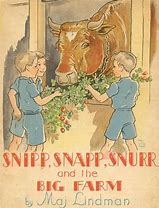
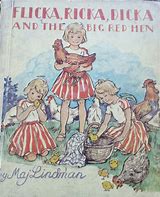
This author/illustrator from Sweden produced several series of picture books from the 1920s through the 1960s, including those featuring the triplet boys, “Snipp, Snapp, and Snurr,” and also the set of titles built around triplet girls, “Flicka, Ricka, and Dicka.” I’m happy to say that I’ve collected one from each series, which are library editions published in 1960. I see that Albert Whitman & Company has reissued many of these books (some with paper dolls, no less!); but, for me, those actually printed during my childhood mean so much more.

While looking my copies over, recently, I considered what it was that I had liked so much about them as a child. Possibly I can put some of my discoveries to use when fashioning my own books for young readers. I came up with the following factors:

  • Settings – The country’s name, “Sweden,” is stated in two out of the three books that I own in these series. Even when not mentioned outright, the setting depicted in the book feels very different from my neighborhood that was in the midst of a small town in Michigan.
  • Freedom  – Since many of the stories take place on farms or in other rural areas, the children often seem quite free to roam as they please and have many adventures that often involve animals, as well.
  • Names – Beyond the triplets’ monikers, many of the other characters have names that were also unfamiliar and interesting to me.
  • Family structure – Until I was somewhat older and a nearby neighbor gave birth to triplets, I had never known any such families. (Imagine my surprise when that trio was made up of one boy and two girls!).
  • Visually appealing – The lovely, full-page illustrations are so pleasing to the eyes, and many of the editions use a somewhat enlarged and easy-to-see font.
  • Simple stories that often involve extended families – This serves as a vehicle to get the children away from their homes and broadens the story options.
  • Surprise endings or subtle lessons to be learned – As I remember, the resolutions seemed satisfying to me as a child.

All that being said, it appears that some of the books are rather long and run over 1200 words. My mother preferred to read shorter books for story time, especially since I also had an even younger brother. My father usually chose to tell us stories that he made up, on the rare evenings when he arrived home early enough from work. My older sister was always eager to read to me, though, for which I am forever grateful.

snipp, snapp, snurr

Although the type of stories that appeals to today’s children has evolved, I’m sure, I believe that there are still some nuggets of basic childhood yearnings to be found in the pages from our youth. I’d love to hear about your favorite childhood books and what it was that drew you to them!